
August 09 2025, 19:52
The Girl on a Motorcycle
I’m pleased with myself for seeing one of these #ArthouseSummer films in the cinema. The BFI South Bank is an amazing space, and it’s been several years since I’ve visited, so I’d forgotten how they have red curtains in NFT2 and how uncomfortable the seats are. Also, the weirdos.
A guy made a beeline for me in the foyer, an older fella getting far to close to me, and I had to do an unexpected pause and side step to get away from him. He then sat next to me in the film. My seat was booked hours earlier, but I can’t believe it was a coincidence, he must have crashed someone else’s seat. He struck up a conversation.
‘What brings you here to watch this film?’
I was confused. His emphasis was provocative. ‘Well, I’m writing some blog posts on arthouse films...’
‘You think this is an arthouse film?’
‘I haven’t seen it yet. I don’t know. I hope so.’
‘What are you writing?’
He didn’t seem to understand what a blog was, or pretended not to. ‘Posts on the internet.’
‘Well, whatever, you follow your dreams.’ The derision was floating around him in a cloud. ‘But it’s not good. It’s certainly not arthouse. It’s a piece of crap.’
‘I hope that’s not true. Look, please don’t spoil...’
‘And have you met her?’ He pointed towards the front of the cinema.
‘I don’t know who you’re pointing at...’ The penny dropped. ‘Marianne Faithfull? No, of course not. Have you?’ I knew the answer before I’d finished asking.
‘Yes. She was awful.’
At this point I exploded. ‘Are you going to spoil this for me? I’ve asked you not to. Are you going to be trouble? Because if you are I’ll have to move.’ I could sense the people around me listening to all this, but I was furious.
‘Okay, if you don’t want to talk, I’ll leave you alone.’ He pulled a large black backpack off the floor, heaved it onto the empty seat to his left, pulled out a large bag of sweets and started rustling them loudly.
Reader, I left the cinema. At the entrance, I spoke to the usher and he said just to sit anywhere once the film started, so I zipped down the front when he closed the rear doors and got an aisle seat, which was perfect. (I should say something about the film!)
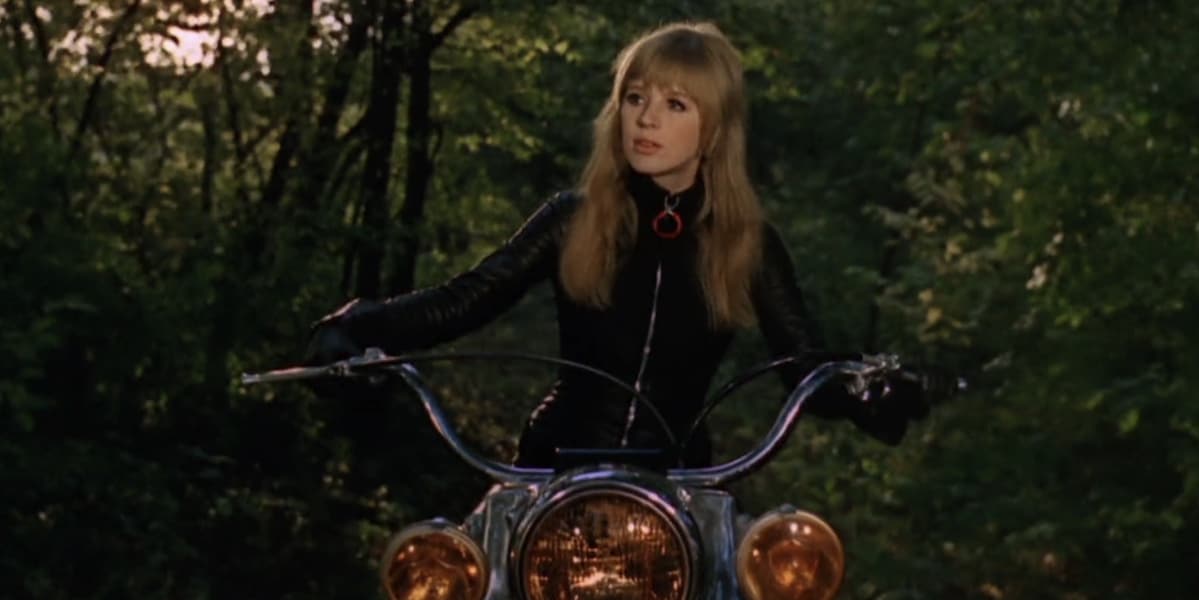
Newly married Rebecca is given a motorbike as a wedding present by her sadistic lover, Daniel. Her husband, Raymond, allows her to keep it, and one morning she secretly sets off from their French home across the German border to visit Daniel in Heidelberg. We discover her story as part of her journey.
If I’d seen the film at home, I don’t think I’d have finished it, but there was something about it on the big screen that made it sing. It’s cheesy, the dialogue is often clunky, and Marianne Faithful gives an over-the-top performance, but damn it if I didn’t have a really good time. They showed the Alex Cox Moviedrome introduction to the film, and he’s pretty dismissive and snide about it, but I think he misses the swings director Jack Cardiff is going for.
It might be overgenerous to say the film is deliberately funny, but it’s definitely knowing in some of its humour, and it wrestles with ideas of marriage, monogamy, marrying young, what it means to be free, free love, types of masculinity, and indeed femininity... and it’s playful.
It’s not erotic, which was part of its marketing/mystique, because whenever there is sex, the screen pulsates with neon pinks and greens. It’s an experimental film, for sure, and the narrative unfolds in flashbacks and dream sequences to clever effect. It’s incredible, based on its current reputation as a bad cult film, that A Girl on a Motorcycle was the sixth most popular film on general release in 1968. It’s not a masterpiece, but it’s far more ambitious than most things that get made today.
August 06 2025, 21:59
Irma Vep
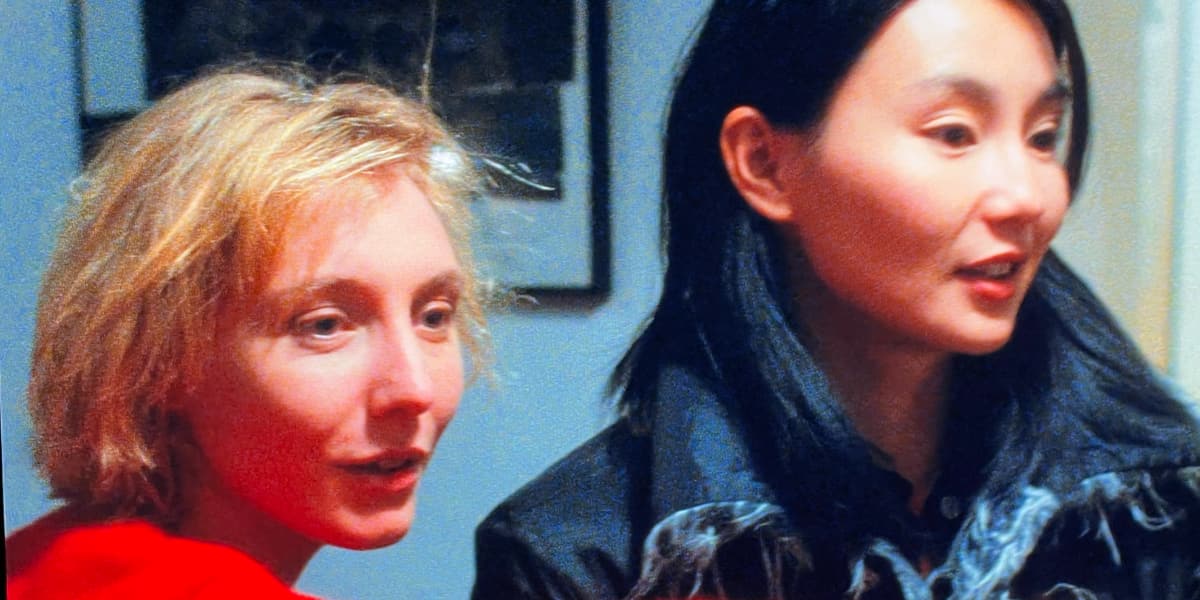
Hong Kong action star Maggie Cheung arrives in Paris to take the lead in a remake of a classic silent film, Les Vampires. The cast and crew are friendly, but Maggie is an outsider, and the group's conflicts and histories become increasingly pronounced as director René begins to realise the film is not working. Costume designer Zoé has a crush on Maggie, leading to further complications.
I thoroughly enjoyed this. Sometimes a film hits you just right. The camera weaves between the people working on the film set so that it feels like we are eavesdropping. Each character has some sort of grievance or flaw that plays out through the story. Maggie Cheung, playing herself, navigates with charm the petty politics and negative opinions of the film (and French cinema in general!), staying ever the professional as things falls apart around her.
René’s film is based on an infatuation with the idea of Maggie Cheung in a catsuit. That’s his entire energy for the film, and once she arrives and he gets what he wants, because the script isn’t good enough to sustain the idea, he has a nervous breakdown. As an actress, Maggie needs to understand what her director wants from her. Distraught at the creative failure of the film and not being able to help, Maggie wears the latex catsuit to sneak around her hotel, as if she is Irma Vep, her role in René’s vision. She steals a necklace—but was it a dream?
Unwilling to be replaced on the film, René makes a cut from the footage for the new director which is completely unhinged and wonderful. Perhaps Assayas is saying that French cinema has the possibility of being more adventurous, for all the film’s talk of it being stuck in the past. This was made in 1996, almost thirty years ago. It makes me want to find out what happened.
August 04 2025, 19:48
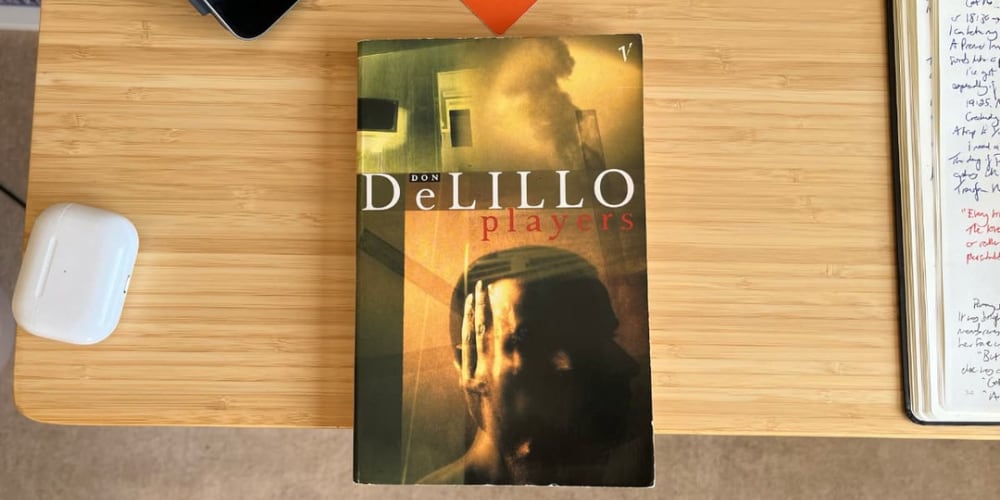
Players
210 pages, two acts, 10 chapters, ~60,000 words.
I disliked this book at first. Two voices, Lyle and Pammy, intertwine in the opening chapters, where he is a trader on Wall Street and she works in marketing for a grief counselling service run from the World Trade Center. They’ve become friends with Ethan, an older man Pammy works with, and his much younger partner, Jake. My initial take was that these were people who didn’t talk about anything meaningful, hiding behind banalities, especially Lyle and Sammy who have their own relationship speaking style that quickly grated on me.
The first half of the story sees Lyle begin to investigate a minor terrorist attack on his trading floor, leaving Pammy to spend more time with Ethan and Jake. Lyle is a sucker for patterns and, we start to realise, doesn’t feel like other people, or particularly empathise with them. He hooks up with a new secretary on the trading floor to find out how the attack happened, who did it, and how he can thwart them next time, although that veneer of respectability becomes doubtful as the story unfolds.
Pammy, on the other hand, looks for a connection with Jake when he reveals to her he’s not really gay, but that gambit backfires spectacularly. Jake is the character with the clearest sense of his feelings, but his vulnerability is his downfall, and Pammy retreats to her apartment and relationship with Lyle for safety. But Lyle doesn't seem to have Pammy’s sense of the limits of what she will do. Lyle and Pammy are reliant on each other, but in going so strongly in different directions, it’s implied they break apart. Lyle seems to be truly lost in the web of conspiracy theories and lies he finds so fascinating. At least Pammy is looking for life in the right places.
Players reminds me of a book I read earlier this year, Martin Amis’s Success, with its two half brothers alternating chapters and gradually growing catastrophically (for one of them) apart. That was a hard book to like on first reading, but it grew on me as I gave it more attention. It’s the same with Players. DeLillo’s sentences are exquisite, but he makes you work for the meaning behind them.
August 03 2025, 16:44
Le Samouraï
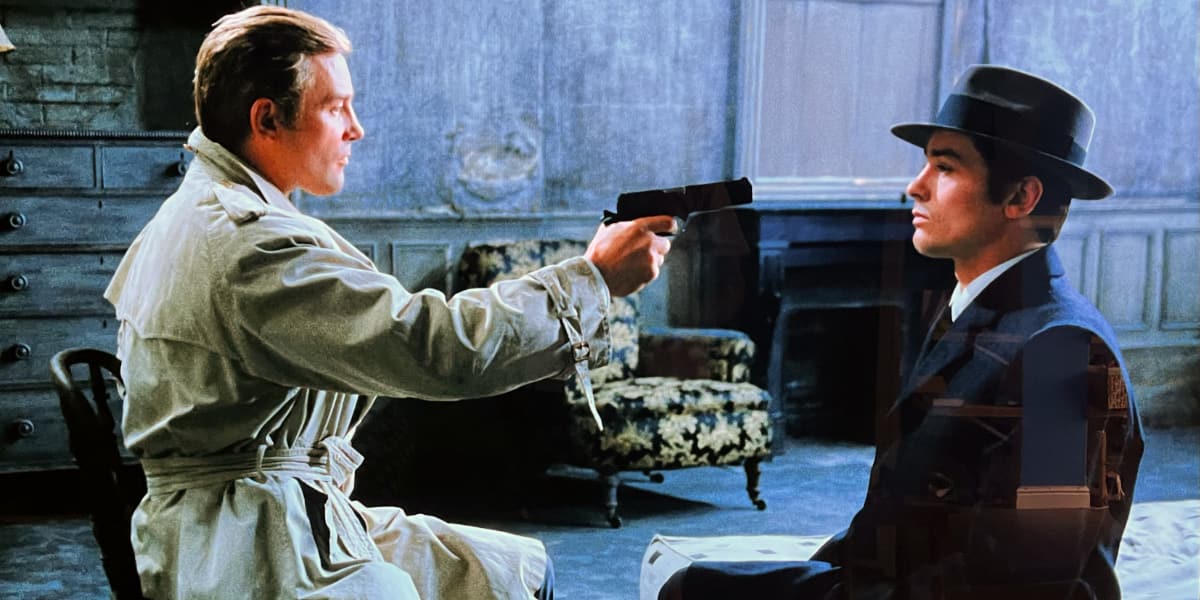
Hitman Jef Costello takes a contract to kill a nightclub owner, but he is seen leaving the premises by several employees. Despite having a watertight alibi, the police superintendent doesn’t believe Costello and puts him under surveillance. Meanwhile, Costello’s employer is unhappy with the police involvement and the hitman has to find a way to get both parties off his back.
This feels like a seventies film, so it’s amazing to me that it was made in 1967, four years ahead of The French Connection, seven years before The Conversation, both of which take chunks of Le Samouraï’s DNA. Thinking about it, many films flow from here, including Ghost Dog, The American, Drive, The Killer... but then, Melville was heavily influenced by the gangster and noir films put out by Hollywood in the 40s and 50s, so it all goes around.
Alain Delon hardly moves his (beautiful) face, and the lack of emotion is deliberate, but it makes Costello a hard character to care about. The final scene is set up by a subtle display of remorse, but it wasn’t enough for me to feel much for him. Like Tati’s PlayTime, it is flawless in what it sets out to do, but doesn’t let you close to anyone. It’s technically perfect, but too cold for me to love.
August 02 2025, 16:03
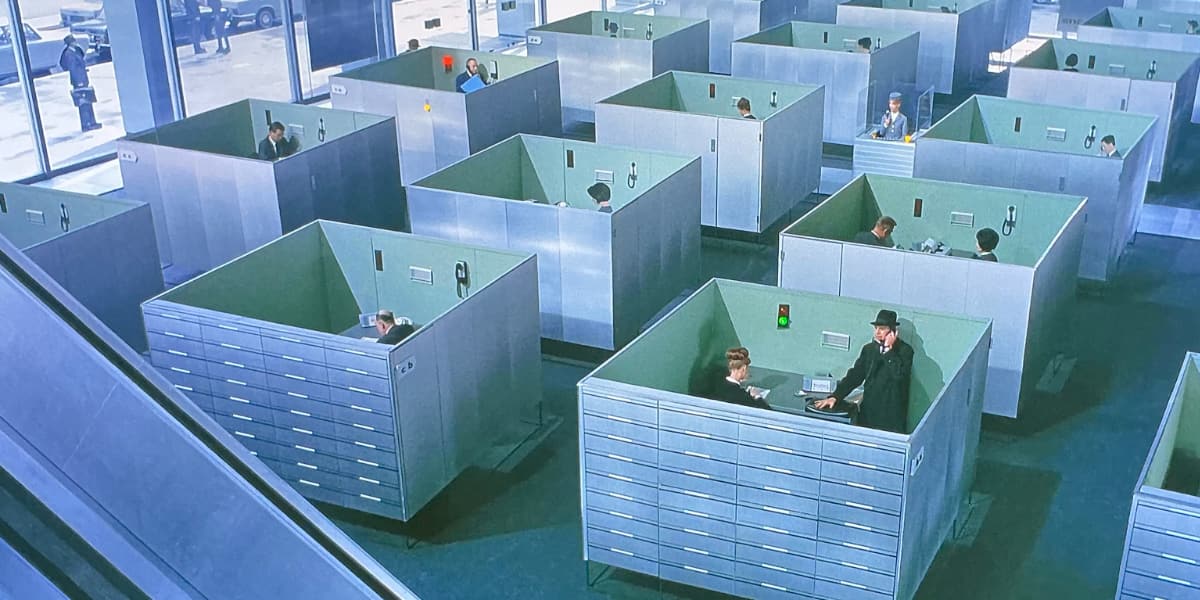
PlayTime
Monsieur Hulot arrives in the centre of Paris to meet a man about some business, but his attempts to connect are thwarted by the distractions and mechanisms of a modern city. Other people come and go—tourists, businesspeople, tradesmen—culminating in a chaotic dinner at a the opening night of a new restaurant.
There’s no real plot to PlayTime. The city is the main character, a precisely rendered alternate reality where everything runs like a clockwork machine, the buildings full of box-like rooms, and the latest gadgets being presented and sold at all times. Hulot brings a clumsy humanity to the sterile environment, which is like a children’s book version of adult life.
The first half of the film presents a series of comical set pieces, each one bursting with small jokes and events in the foreground and background. It’s impossible to know where to look. I would imagine I would see more on a second viewing. Like the adult world, watching PlayTime is often amusing, but also repetitive and sometimes dull, even with so much going on. It’s like looking at an ever-changing piece of art in a gallery for two hours.
The second hour is mostly set in a newly opened restaurant with many jobs in the building still unfinished. Design mistakes cause staff to trip over, collisions, electrical faults, and all while an increasing number of people flow into the space, until the chaos of humanity overwhelms the architect’s vision, the music gets more raucous, and fun is had in spite of the collapsing dining room. Tati’s message seems to be that for all of modern life’s restrictions, people will find a way to connect and have fun.
August 01 2025, 19:21
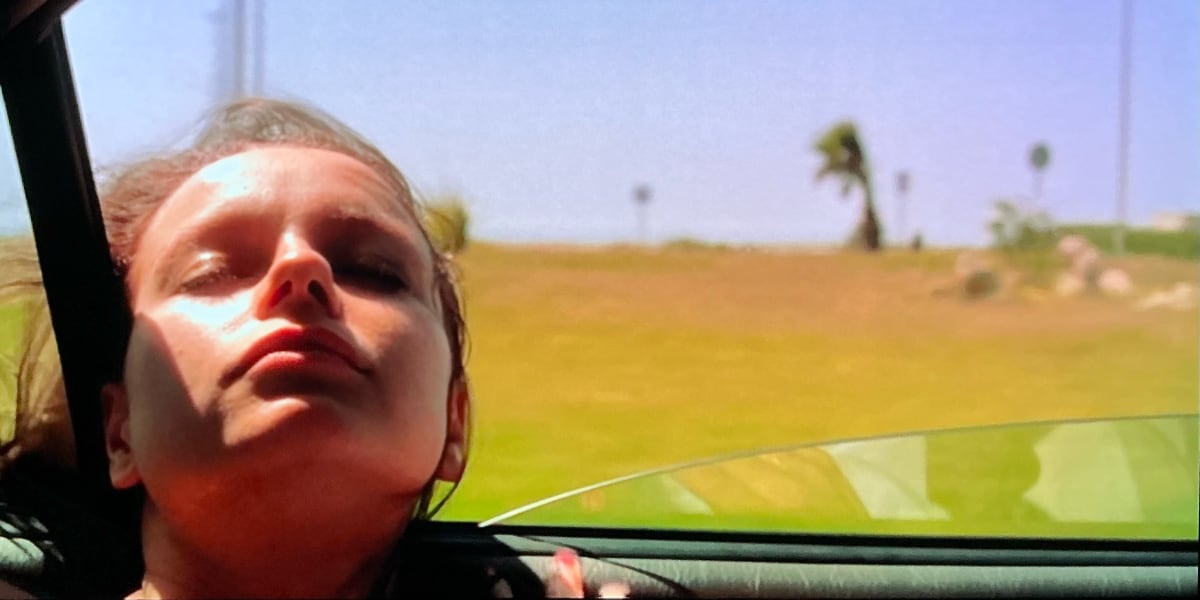
Morvern Callar
On Christmas Eve in a Scottish port town, Morvern Callar finds her boyfriend dead on the floor of their flat. In a suicide note, he asks her to send out his unpublished novel to a list of agents. Morvern is trapped in a supermarket job and has no family, so she convinces herself he means for her to post the novel under her own name. She uses the remaining money in his bank account to take her closest friend, Lanna, partying in Spain, and she doesn’t expect the swift response from an agent who loves her book.
I hadn’t seen this film in years, but the novel is one of my favourites. I wanted to repair the damage of not enjoying the film of Picnic at Hanging Rock. Lynne Ramsay and Liana Dognini cowrote the screenplay and, like Picnic, it holds true to the book and sticks closely to the narrative, but for me Morvern Callar is in a different league. Samantha Morton as Morvern and Kathleen McDermott as Lanna are luminous. They shine through the dynamic camerawork, playful use of music (her boyfriend leaves Morvern presents to unwrap that include a Walkman and a mixtape), and the girls’ wickedly infectious personas. It’s gritty and fun and hopeful, and now one of my favourite films.
I think my problems with Picnic at Hanging Rock were that, yes, I don’t particularly like straight period dramas, even clever ones, but more than that, the characters don’t go through any real internal changes. Morvern’s gradual maturing is the beating heart of Morvern Callar.
I love Morvern. She makes what to her are pragmatic decisions around her boyfriend’s death: she accepts his novel as a gift and puts her name to it; she uses his funeral money to go to Spain and disposes of his body; she processes revelations about her closest friend in a stoic and surprising way. And with each decision, she becomes more mature, more outward looking, and begins to imagine a bigger life.
July 30 2025, 20:08
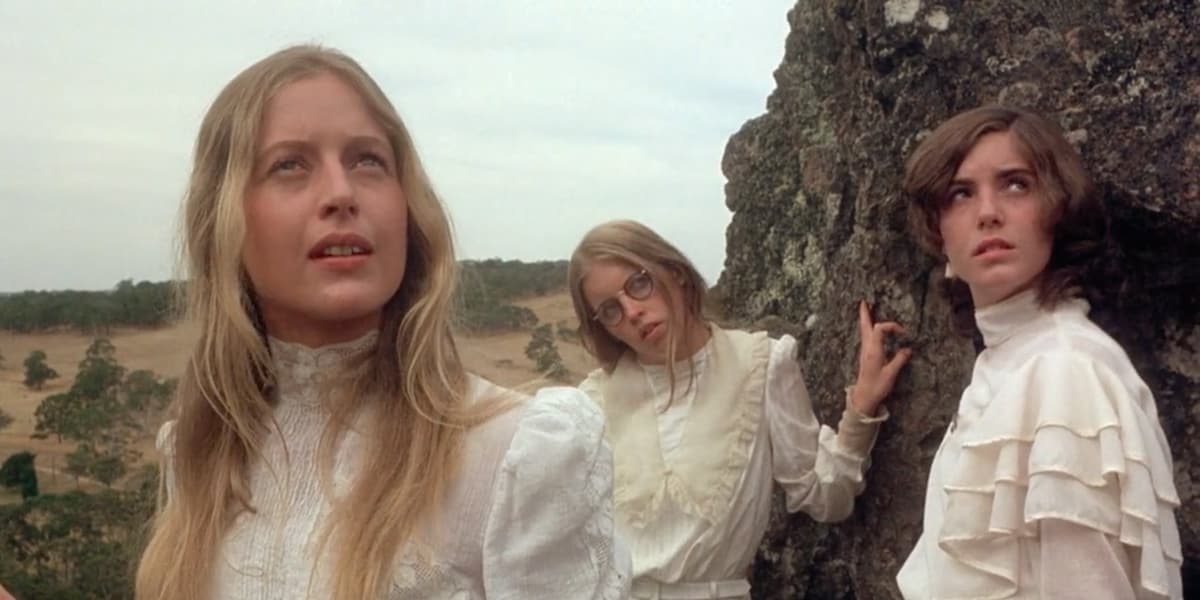
Picnic at Hanging Rock
On an outing from their boarding school in the Australian outback, four girls wander around the base of Hanging Rock and are tempted to climb higher. The rocks seem to have ghostly powers and the girls fall asleep in a stone circle near the top. Three of them walk through a gap and disappear. A teacher from the group is also seen walking up to Hanging Rock and also goes missing. The mystery engulfs the school and the local community.
It’s clearly an excellent film. The schoolgirls all give strong performances, the audio is cleverly used to make the viewer feel unsettled watching the corseted, gloved girls in an ancient wilderness teeming with insects and birds, but... I couldn’t get into it. Because I only read the book last week, the faithfulness of the adaptation makes the film seem uninspired. Chunks of dialogue are taken straight from the novel. I can’t seem to see the film on its own merits.
This hasn’t happened to me before. I wrote notes on the book at the weekend on Patreon, and there’s no point in repeating myself. I don’t think the film brings enough new to the story. There’s a stronger focus on the potential lesbian relationships in such a female-centric community, and the friendship between Michael and Albert has gay undertones that I didn’t pick up in the book, but it isn’t enough of a differentiation. A disappointing experience.
July 27 2025, 21:35
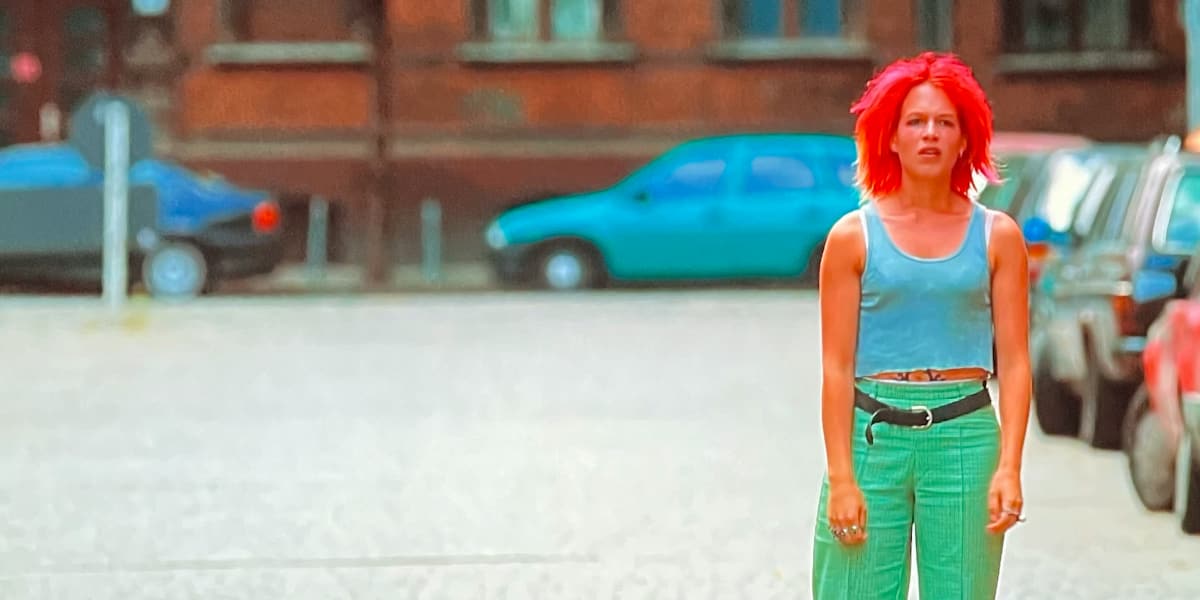
Run Lola Run
Lola and Manni are at a relationship crossroads. Manni is trying to make a living doing jobs for a Berlin gangster, Ronnie, and as a test of competence is told to pick up 100,000 DM of diamonds, sell them and bring the money to a rendezvous at midday. He accidentally leaves the bag of cash on a subway train and phones Lola in desperation. She tells him she will fix things, and she’ll meet him with the money he needs—but she only has twenty minutes to somehow make things good.
I saw this in the cinema when it came out and I remember being blown away by the mixture of pulsing techno, Franka Potente running through the streets of Berlin, and the looping narrative. I hadn’t seen anything like it before. I’d forgotten the animation, the philosophical game the film is playing, and the ways character arcs spin in different directions each time Lola’s actions deviate in very small ways.
It’s a beautifully edited film, and it plays with the ideas of free will, destiny, chance, desire and love. Lola’s agency creates the second loop through the timeline, and it’s ambiguous if Lola or Manni create the third, but each time through Lola seems to remember small details from the time before, and her screams at moments of extreme stress certainly bend reality to her will.
The central question of whether the couple can be together is answered when Manni steps up to solve the problem he’s created for himself. There’s an implication from the beginning that he tends to rely on Lola fixing things for him. By the end the lovers are equal.
July 25 2025, 13:49
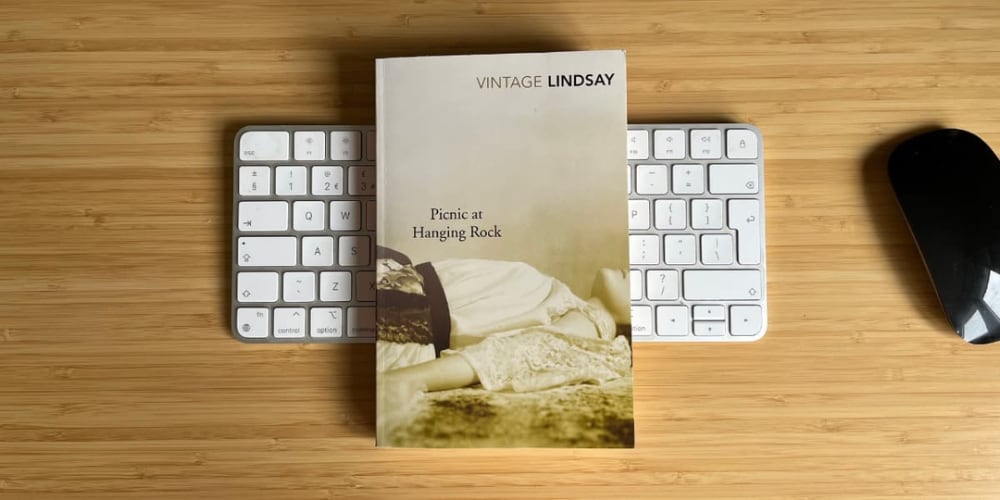
Picnic at Hanging Rock (novel)
~110,000 words. Third person, many characters.
My daughter bought this for me for my birthday in March, and I wanted to watch the Peter Weir film for #ArthouseSummer2025, so it seemed right to read it before the film images infected my imagination.
Three schoolgirls and a teacher go missing while on a picnic at Hanging Rock, a volcanic rock formation in Victoria, South Australia. The police and locals search the area but can’t find them. A week later, two men return to the site and miraculously find one of the schoolgirls still alive. She has no memory of the incident, and the mystery of the other missing girls lingers and affects people in unexpected ways.
The story unfolds through the eyes of the many characters linked to the boarding school and local community. In the opening chapters, I was overwhelmed by the number and variety of perspectives. It’s impossible to remember who is who at first. The authorial voice is front and centre, and it’s told as if it is a true story, including letters and newspaper reports. There isn’t a single protagonist; instead we observe people going about their lives at all levels of Australian society, from the schoolgirls, to gardeners and cooks, teachers, police, holidaying gentry, settlers, and the Appleyard School’s malevolent owner and headmistress, Mrs Appleyard. The effect is a chorus of voices worrying over their lives with the central mystery of the disappearances always in the background.
The details of the natural world and structures (physical and social) humans create in it are exquisitely captured. There is a consistent sense that nature hums behind everything the characters do, in insects, vegetation, weather—sometimes they notice it, but usually they don’t because they are caught up in the social and economic necessities of their lives. The Hanging Rock inspires both awe and fear. Humans are a small part of nature’s ecosystem, and the rocks are a reminder of individuals ultimate insignificance, as well as the threat of chaos cutting through attempts to feel in control in the unpredictable wilderness.
The novel seems to be saying that some things are unknowable. On a process note, Lindsay wrote a final chapter that her editor advised they cut out, and that decision gives the book its defining mystery. While poking around on Wikipedia, I read the summary of the original ending, and while it makes sense of the whole book, it also detracts from it, because pondering the mystery of the events is why to me the book is powerful. Part of me wishes I hadn’t found out the author’s intention, or at least not so quickly after reading the last sentence. It's a curse of the modern age to have facts so readily to hand. It’s probably better to engage with a piece of art on its own terms, at least for a while, to get a fuller experience of it, before trying to find out more.
July 23 2025, 14:23
The Fog
~110,000 words. Third person, many characters.
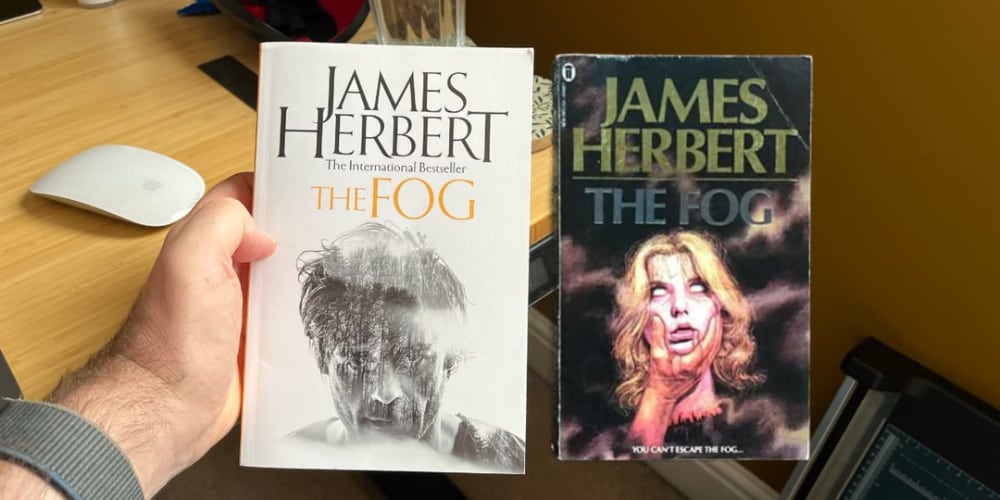
This is one of those formative books for me. I mean, look at the cover! The one I have now is on the left, but the hastily Photoshopped one on the right is the edition I owned in my teens. My father was bringing horror books into the house all the time growing up, and I think I discovered Herbert’s Lair first, which was the follow-up to his first novel, The Rats. I remember a classmate reading The Rats in school and showing everyone the gory bits. For emotionally-stunted twelve-year-olds, these were catnip as representations of the repressed horrors of adolescence.
The Fog mostly follows John Holman, an environmental inspector who specialises in covert investigations of Department of Defence land. An earthquake opens a crack through a rural English village, demolishing it and releasing a yellow-tinged fog into the atmosphere. Holman’s car falls into the hole and he is one of the first to be exposed to the fog, which sends anyone in contact with it insane (usually into a sadistic rage). He is the only person to recover, and he is asked by the government to help as the fog is blown around England leaving mayhem in its path.
I didn’t remember much about this beyond one standout scene that was tattooed into my brain involving a private school, a possibly paedophilic teacher and some pruning shears. Holman is the protagonist, but the point of view jumps between many characters as they are affected by the fog. It’s astonishing the range and depravity of the things Herbert imagines people doing to each other, and each character gets a back story, perhaps an injustice, and then a horrible revenge and death. It’s a collection of short stories in that way.
It drags in the second half, more like an uber-violent sixties Doctor Who, with the army personnel, provincial English life, government officials from the MoD, and a bordering-on-alien enemy. By the time the fog reaches London, the extended route Holman is forced to take to find the fog’s heart allows Herbert to describe a Hieronymus Bosch–style hellscape of brutality and despair. It’s written well enough, but there’s no character development or subtext—the seventies equivalent of Victorian penny dreadfuls.
It was fun to revisit. I wouldn’t want another any time soon.