
May 03 2025, 20:34
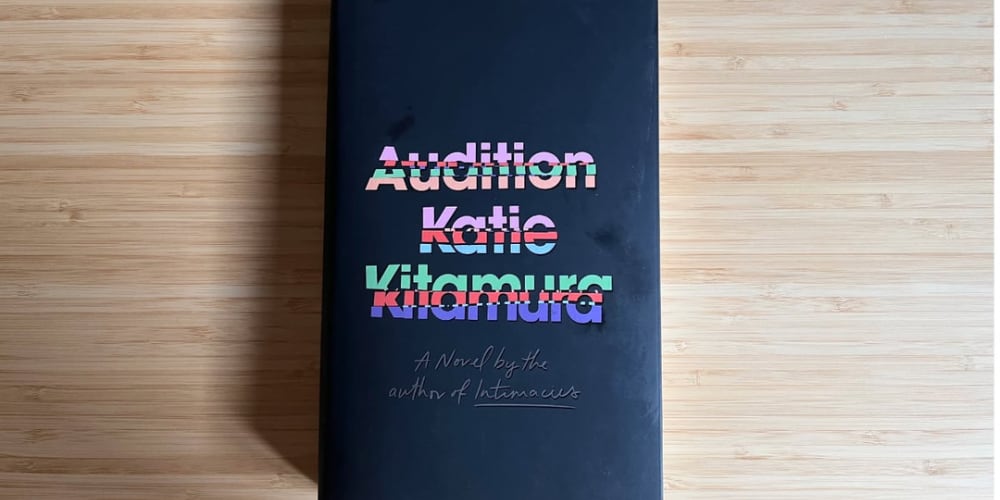
Audition
Published by Fern Press, an imprint of Vintage, which is owned by Penguin Random House. 200 pages, ~50,000 words, 13 chapters, so ~4,000 words per chapter. It’s a short novel. Or possibly two novellas.
The nameless narrator is an actress married to Tomas, a writer, and they don’t have children, but in the opening she meets at a restaurant a young man, Xaviar, who is convinced she is his mother. Feeling conspicuous and judged as being too old to be dating Xaviar, she is thrown into guilt when Tomas walks in, looks around, and immediately walks out. This scene sets in motion a series of events at home as well as in the rehearsal space of the play she’s in.
But then, just as it is building momentum, at the halfway point the characters are shaken around so that Xaviar becomes the narrator’s son, and Tomas his father. This is the plot, such as it is. The narrator is more than unreliable—reality bends and eventually snaps.
The book is about pretending. Is Xaviar a highly skilled con artist? Is that what actors are? Which parts of relationships are real and which roles we play without much thought? The narrator dissects the performative aspects of her family to the point that she doesn’t seem to know anyone, not even herself.
In the first half, she has curtailed her affairs to be with Tomas, her stoic, comfortable husband, but Xaviar kindles old lusts. In the second half, in a jolting handbrake turn, Xaviar becomes her real son, moves back in with her and Tomas, and it’s his girlfriend, Hana, who sends Tomas into an awkward sexual heat.
In both versions, the action is picked apart with the forensic eye of a highly skilled actress. The narrator is fascinated by the mechanics of what’s going on between the people around her. She doesn’t seem to trust anyone, and her sophisticated mind tips into possible psychosis. As an actor, she craves the moment where she knows her lines inside out and can explore from within the scene all the variations and possibilities. In life, her boundaries are weak. She doesn’t have lines to hold on to. It takes her months to shed a part she’s been playing on stage, and since the novel is set over the run of a play, it’s impossible to know what of her spoken experience is real.
Previous: Did not finish | Next: Businessmen as Lovers