
May 11 2025, 12:26
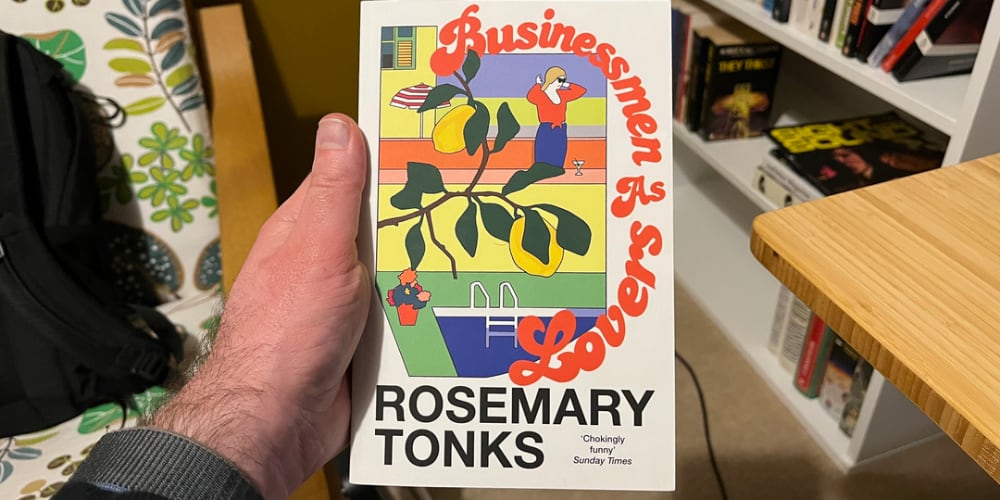
Businessmen as Lovers
Vintage Classics, Penguin Random House. 145 pages, 9 chapters, 300 words/page, so ~43,500 words. A short novel written in first person as Mimi.
Mimi and Caroline, second cousins and close friends, travel by train from England to Italy for a summer holiday at the house of Mimi’s Aunt Evie. Mimi is grieving her mother’s death, but she’s also newly in love with a Reuters journalist she affectionately calls Beetle. Once embedded in their rural Italian villa, with partners and friends around them, Mimi observes the minutiae of her relationships and the politics of village life. A local doctor, Purzelbaum, becomes a villain in the English visitors’ minds, and after a perceived slight on them, a petty revenge is planned.
Mimi has such a wonderful energy that the story flies along in a blizzard of amusing details and raucous conversation with unexpected tenderness and wisdom thrown in. The foreign climes and middle-class Englishness of the characters make it feel like the twenties or thirties, so it’s a shock when the occasional modern detail appears (modern as in references to Marks and Spencer and TV Centre).
These are rich people with privileged lives struggling with matters of business, marriage and how to live a happy life. Caroline’s husband, Killi, is a venture capitalist who is difficult to live with and obsessed with business relationships. Sir Rupert Monkhouse, their neighbour and host, is a quiet archaeologist with a flamboyant mistress Mimi and Caroline admiringly call La Prostitutess. A white-haired man they felt slighted by on the train turns up in the village, to their distress, and is revealed to be a famously well-connected Persian businessman, Chamoun, who gives them sexed-up tortoises as gifts.
It’s a slight and charming tale, written with wit and tenderness, and an insight into a type of leftover colonial Englishness from the sixties that seems to still pervade the upper classes today. Lovely people; annoying people. I wish them well, and they’re welcome to it. Tonks seems to be affectionately making fun of them, but is also quite damning about the way men in particular use business to avoid real life.
The page on Wikipedia about Rosemary Tonks describes an intriguing but tragic life. She was in boarding schools and children’s homes growing up, wrote from a young age, married a man who became an engineer and successful businessman, moved to Pakistan for his work and contracted paratyphoid and polio, returned to Paris, then Hampstead with her husband, where they divorced (but lived on the same street). When she is left nearly blind after an emergency eye operation the late 70s, she goes deeper into spiritual thinking, and eventually kills her decadent literary life by burning an unpublished novel and converting to Christianity. After that, she only read the Bible until her death thirty years later. Sigh.
Previous: Audition | Next: Ghost Wall