
December 31 2025, 19:10
2025: Best films, books and music
I have never pretended to be cool, or to try and keep up with the latest this or that. But, astonishingly, I saw sixty-one films in the cinema in 2025, by far the most ever in my life. The Abertoir Horror Festival in November was a film highlight, and the habit of posting on Patreon notes on each novel I read helped me get more out of my reading experiences. I tried to watch TV (I really did), but nothing stuck (except one).
Favourite film: Black Bag
Favourite book: Fever Dream, by Samanta Schweblin
Favourite album: Moisturiser, Wet Leg
Favourite TV show: Murderbot (the only one I finished)
Favourite video game: PGA Tour Pro Golf (the only one I played, but I played it A LOT).
My TOP 9 cultural things of 2025, in order of preference:
Films of 2025
- Black Bag
- The Ballad of Wallis Island
- Complete Unknown
- The Phoenician Scheme
- The Shrouds
- My Old Ass
- A House of Dynamite
- One Battle After Another
- Jay Kelly
Film discoveries
- Phenomena
- The Old Dark House
- Caché
- Irma Vep
- Matt and Mara
- In the Mood for Love
- Velvet Buzzsaw
- Acidman
- Playtime
Books
- Fever Dream
- Picnic at Hanging Rock
- Moderation
- Businessmen as Lovers
- Fatale
- A Visit From the Goon Squad
- Gabriel’s Moon
- Lost in the Garden
- Success
Most listened-to albums
- Wet Leg, Moisturizer
- Kylie Minogue, Tension II
- HAIM, I quit
- Waxahatchee, Tigers Blood
- Charli xcx, Brat
- Stereophonics, Make ‘em Laugh, Make ‘em Cry, Make ‘em Wait
- Shanti Celeste, Romance
- Angus & Julia Stone, Cape Forester
- Dua Lipa, Radical Optimism
December 30 2025, 16:54
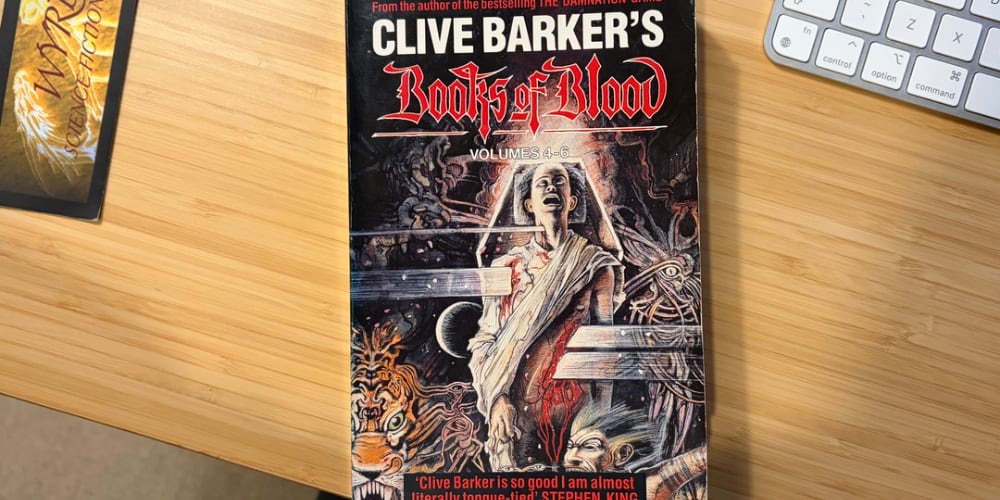
Books of Blood, Vol IV
I’ve owned these stories in compendium form since I was a teenager in the late eighties, but only read a handful then, and I haven’t read any of them since. My memory is that, compared with Stephen King, and even James Herbert, the stories were too gritty and lacked heart. I can’t remember why I pulled the second volume (Books IV-VI) off the shelf now. Perhaps it was a podcast recently where someone read Rawhead Rex? I’m not sure.
It’s a dense edition, with 44 lines per page, and the stories are long, 30-40 pages on average, which makes them comfortably over 15,000 words each, bordering on novellas. That’s not something I’ve seen before. I wonder how he hoped to get them published, or if that was even a consideration. Books of Blood IV has five stories, but Down, Satan! is only a few pages and more like a modern short story in length, if not in content.
The opening story, The Body Politic, was unexpectedly dull, even if the concept of human hands having minds of their own was clever. It felt like an exercise, or an attempt at comedy, but I struggled with it and almost put the collection down. Luckily the next two stories were excellent, with better drawn characters and some decent stakes for them. (It’s good to understand why I don’t like something.) The Inhuman Condition follows a young man in with the wrong crowd who steals from a homeless man an enchanted string of knots. My favourite was Revelations, set in a Texas motel where a wife murdered her philandering husband thirty years before, now visited by a famous preacher and his put-upon wife. It showed a different side to Barker’s writing, more empathic, with female characters, and it was inspiring to see him find a radically different voice. The Age of Desire returns to the multi-character many-points-of-view style of the opening story, and a similar clever concept.
These stories have some DNA from The Twilight Zone, Quatermass/Nigel Kneale, mixed with black magic. I struggle with the concept-driven ones that don’t have an emotional heart. It’s just not my sort of story.
December 30 2025, 11:03
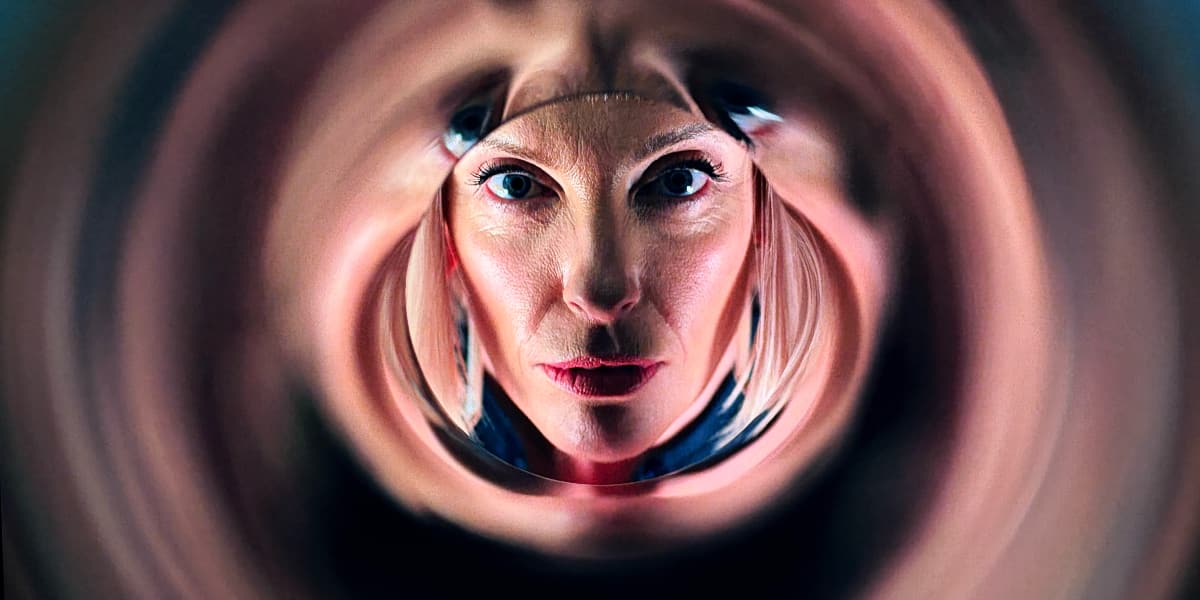
Velvet Buzzsaw
Ambitious art gallery receptionist Josephina has her hoped-for promotion taken away by hard-nosed gallery owner Rhodora Haze. One evening, she discovers the dead body of an artist living in the apartment above her, along with rooms full of brilliant paintings, which she learns the man wanted destroyed. She asks her ex-boyfriend, influential art critic Morf Vandewalt, to confirm her assessment of its quality, and this sets off a battle in the Los Angeles art world over who will profit from the dead artist’s legacy. But the paintings are cursed, and those who profit from them begin to die in gruesome art-related ways.
This is a story of greedy art world snobs getting their comeuppance. Abused as a child, disturbed artist Vetril Dease used his own blood in his paintings, and this seems to be part of the supernatural curse he’s put on them. His art poured out of him onto canvases, cardboard, scraps of paper, anything to hand, and analysis shows there is no discernible pattern to his technique, and no sketches to show ideas being developed. He is a true outsider artist making art to process trauma.
Josephina, played by a wonderful Zawe Ashton, is terrified of being stuck as a receptionist and desperate to rise through the ranks of the art world. Her ambition sets the story in motion, and at first it’s understandable why she would try and save the art works from destruction. The commercial galleries are soon battling to make as much money as possible from Dease’s work, which other artists recognise as both genius and ‘alive’ in some way.
Artists in the film are represented by the cynical, newly sober (and artist-blocked) Piers, played by John Malkovich, and Damrish, part of a collective representing a younger generation. Both men recognise the power of the work and are stimulated to step away from the allure of money and fame to concentrate on their art. They are spared from the curse. Those who make a living from amplifying the work for profit, including selfish art critic Morf, are killed one-by-one by art pieces.
Dease, in death, has the power to punish the greedy and selfish through all art, not just his own. People die via other artist’s work, graffiti, and even tattoos. Everyone making this film seems to be having fun. It’s so good.
December 29 2025, 15:07
2025: Life projects review
I can’t believe it’s been a year since my 2024 life projects review. There’s been less family drama, more culture, and some not-unexpected symbolic shifts. My focus in the first half of the year was physiotherapy and gradually strengthening the muscles around my hips. Then in the summer, things became more varied and interesting.
I’ve been less hung up on writing, and instead done a mix of other creative things—guitar lessons, learning to swim, travelling, reading more fiction, and so on. The Arvon week was challenging, and perhaps it highlighted that I wasn’t ready to go full-on at being a writer in 2025.
Projects in 2025 (chronological order):
- Arvon week-long writing course in Shropshire
- New bathrooms drama
- Mumbles/Gower weekend to see Welsh family
- Family in Vietnam, me at home
- 12 arthouse films in the summer, a.k.a. #ArthouseSummer2025
- Daughter started Sixth Form for A-Levels
- Stephen Hough & Viano Quartet with Guy at Queen Elizabeth Hall
- Lisbon long weekend
- Abertoir Horror Festival of Wales in Aberystwyth
- Swapped knackered old Polo for an electric car
- 12 horror films in December, a.k.a. #12FilmsofBlackXmas
- Logged 28 books on Storygraph
- Logged 132 films on Letterboxd
New skills and habits:
- Strength at the gym and stretching at home
- Swimming lessons
- Guitar lessons
- Posted to Patreon a review for every novel I read
- Meditated most days
December 27 2025, 21:25
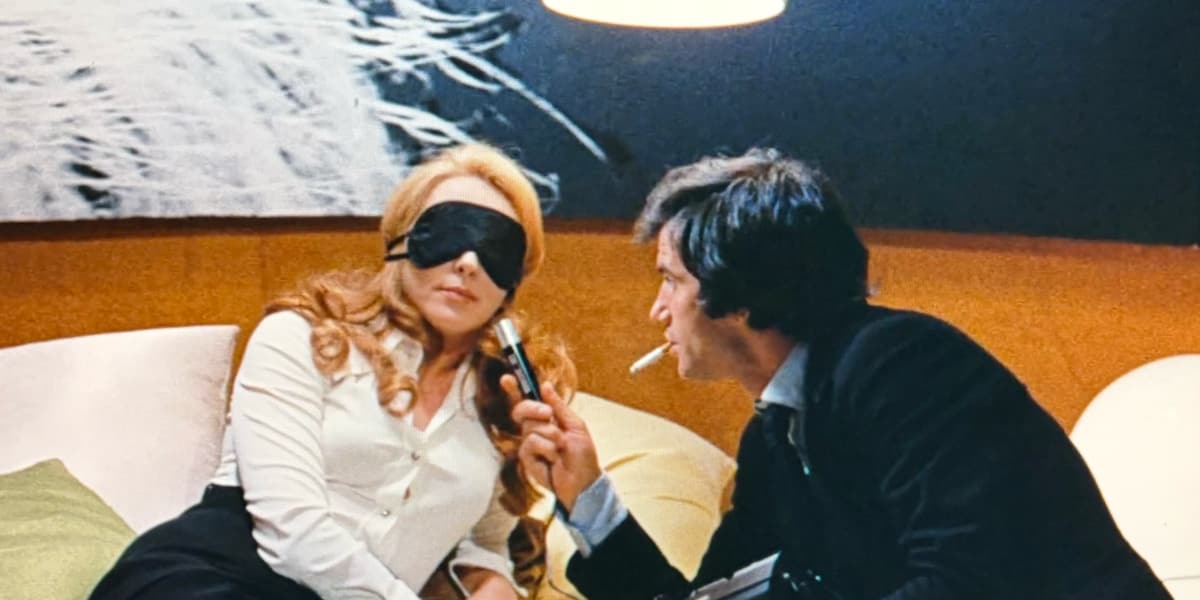
Death Walks at Midnight
On the surface, this had everything I love in a film. It’s a mystery set in a European city, in the world of fashion, nightclubs, parties, with artists as lovers, eccentric minor characters galore, murder with a weirdly brutal weapon... it could be perfect. None of this matters if the pacing is off, the dialogue is dull, and there’s no character development.
Valentina is a freelance model making a living from her looks and good reputation. She decides to take part in a scientific experiment with a new hallucinogenic drug, and whilst high has a vision of a woman being brutally killed by a man wearing a spiked metal glove. The experiment is a tabloid stitch-up, and on publication of the story she loses work because of the drug use, and worse, the killer is real and needs to kill her before she identifies him by name.
I loved Valentina. She’s smart, confident, money-focussed, resourceful and beautiful. The men in her life seem to be symptomatic of the times—sexist, entitled and rude—but she holds her own with them. There’s a running theme of women not being believed and powerful men locking them away. There are plenty of cliché characters. It’s so frustrating. And the final ten minutes becomes an extended fight and chase scene on a rooftop that reminded me strongly of Dario Argento’s The Cat o’ Nine Tails from the year before.
It’s derivative and lazy, but I had fun with Nieves Navarro as Valentina, and I’m a sucker for artist’s studio and gallery scenes. There just isn’t much art or artists in modern thrillers. Italian gialli celebrated art and the artist. It adds a layer to the mysteries that I find charming and stimulating.
December 26 2025, 21:43
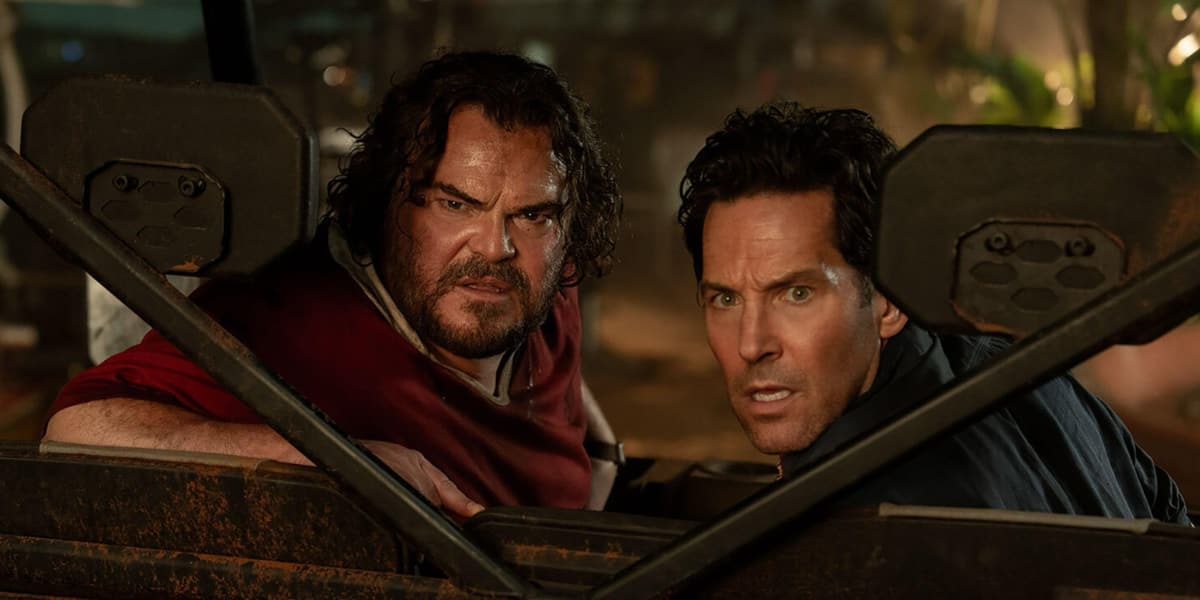
Anaconda
I was trying to find a film the whole family would enjoy at the cinema on Boxing Day, and when I saw Anaconda, certificate 12A, with Jack Black and Paul Rudd, I thought I’d hit the family jackpot—but neither child wanted to come, so the jackpot was all mine.
Failing actor Griff turns up at his oldest friend Doug’s birthday party with a VHS copy of film they made together as teenagers. Doug is depressed because he sees his dream of making a film slipping away. Reinvigorated by the memory, Griff convinces Doug, along with actress Claire and cameraman Kenny, to travel on the Amazon river to make a new version of the nineties horror film, Anaconda. However, their boat captain Ana is on the run from a group of armed men, and there is a real monster Anaconda roaming the river.
It’s a goofy comedy, and if you know and accept this going in, it’s a great ninety minutes at the movies. There are a couple of scenes that really made me laugh, and I only laugh out loud like that when I’m emotionally invested. Of course I see myself in the Jack Black character, a middle-aged man chasing an unlikely dream while stuck in a 9-to-5 job with a family to support, and perhaps I just needed to be reminded of the joys of making something with friends. The foursome are incredibly likeable, and there is extra comedy in Selton, the snake handler they hire, with an intense emotional investment in his snakes, and some late cameos. Happy Christmas.
December 21 2025, 18:58
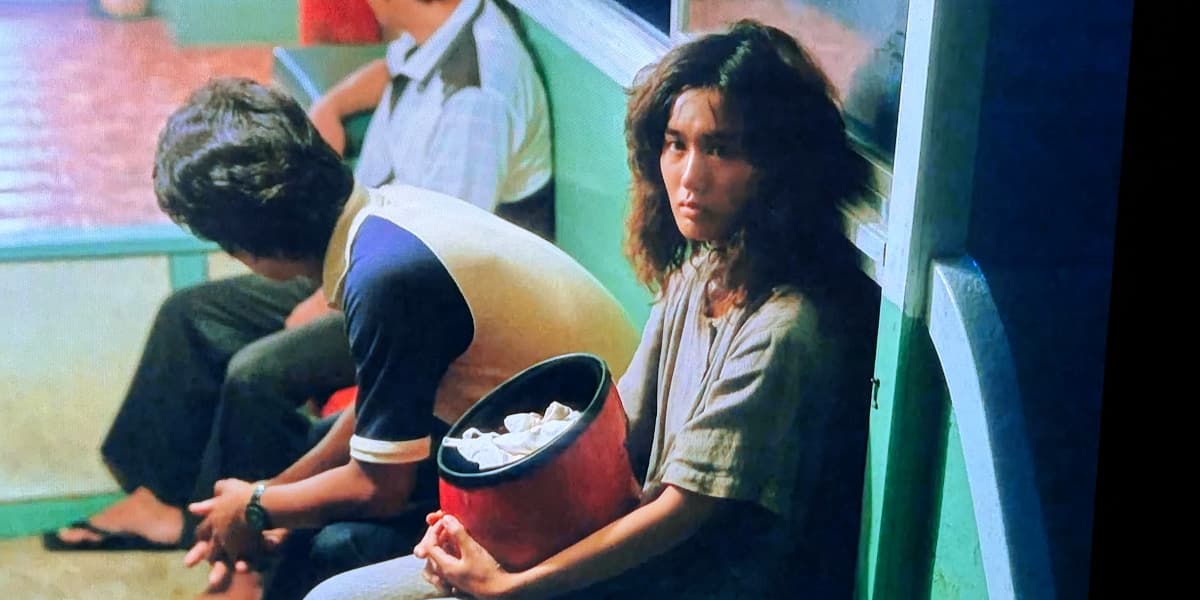
Mermaid Legend
On the Japanese coast, a newly married couple bicker on their fishing boat. Migiwa dives for shellfish, and Saeki minds the rope to pull her up. One night, Saeki sees a fellow fisherman killed on the water by a passing speedboat, and when he takes Migiwa to investigate, he is harpooned in the chest. Migiwa survives and goes into hiding, but as she begins to understand what’s going on in the village, she is driven to revenge.
Migiwa can hold her breath for several minutes in her foraging on the sea floor and is like a mermaid. Every day she prays to Buddha for luck and guidance. When Saeki is killed, the police try to pin his death on her, and his oldest friend Kaisuke steps in to help, but the best he can do is try to hide her on an island populated only by women. The details of this world are fascinating. The people living in these villages have simple lives, praying to Buddha and trying to stay out of trouble in the economic aftermath of the Second World War.
Migiwa is a spirited heroine, grieving her husband, wrestling with her limited options, and putting herself in harms way to understand why her husband was killed. When it becomes clear it was to do with a corrupt business deal and a contract for a new nuclear power plant, she asks Buddha for guidance one last time. With seemingly supernatural powers, she goes on a murderous rampage at the nuclear plant’s opening ceremony.
The final twenty minutes are the reason I saw this film on Shudder. It’s a choreographed stabbing spree in a variety of constricted spaces. Nobody can hold her or disarm her as she avenges both Saeki’s death and all the suffering she has been put through. The blood sprays red everywhere. It’s cartoonish in places, and while it is amusing to see her slay the businessmen and Yakuza gangsters, there are disturbing echoes of modern day multiple stabbings in shopping centres and cars driven into busy markets. Revenge is in the eye of the beholder.
December 19 2025, 16:00
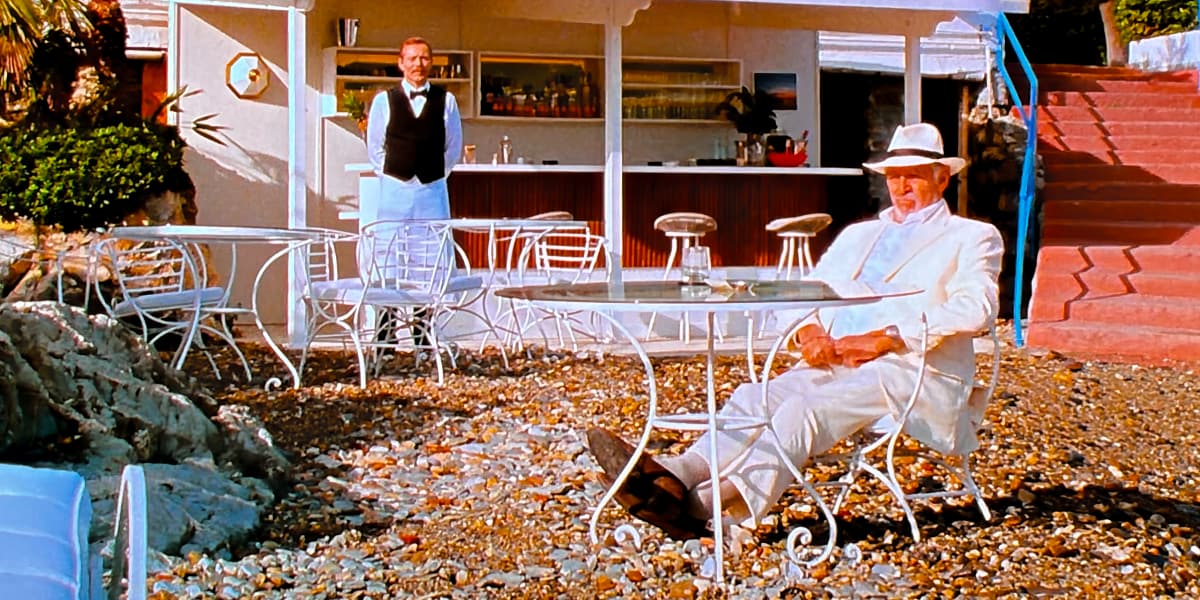
Reflection in a Dead Diamond
Yikes, the plot of this one... John Diman is an old man staying at an expensive hotel on the French Riviera, but he was once a secret agent for a clandestine government organisation. He spent years trying to catch a leather-clad female assassin called Serpentik, but she evaded him to the end. Memories and reality merge as he walks the hotel grounds and wonders if Serpentik has at last come for him.
It’s rare to find a film that is so impressionistic and reliant on associations through cuts, slides and jumps of editing, that you can get almost to the end and still not be sure what exactly is going on. It jumps through time, between characters, between the actors playing characters, and more, in an exhilarating and thoughtful way. It’s a love letter to a sort of film that was everywhere in the sixties, especially in Italy—the cheap euro-spy-thriller cashing in on the popularity of the Bond films.
The camera effects and costumes and dialogue are familiar from other genres I do know, and I can’t think of anyone better to do a film like this than Bruno Forzani and Hélène Cattet’s, who have done a similar job with giallo (Amor) and spaghetti westerns (Let the Corpses Tan).
Serpentik is a fascinating villain (or is she?), with an ever-changing face, an array of feminine weapons (steel nails! hair hooks! poison rings! samurai swords!), and a barely concealed rage that is amusingly counter to Diman’s confused lust and professional outrage that he can’t catch her. And the ending is deliciously ambiguous.
December 14 2025, 10:59
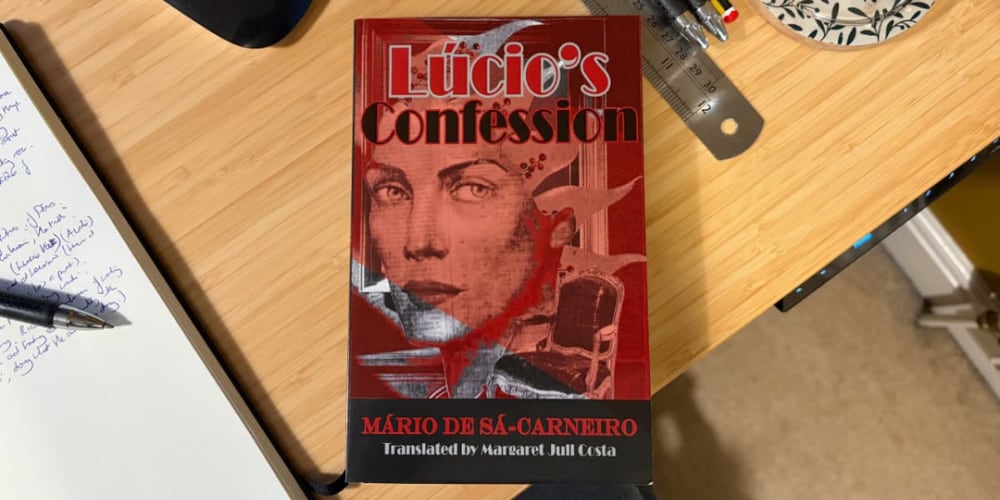
Lucio’s Confession
105 pages, 8 chapters, ~38,000 words
I bought this while visiting "the oldest bookshop in the world", Livraria Bertrand in the Chiado district of Lisbon, at which the staff stamp the inside cover in a cute proof that it was bought there. There was a small English-language section, and only a handful of books by Portuguese authors translated into English. This one jumped out at me because of the red cover, suggestive blurb, a quote from The Sunday Times describing it as “a thoroughly decadent story of an unusual menage à trois which ends in a killing”. I mean, of course—I’m in!
Lucio Vas is a writer in Paris in 1895, enrolled to study Law, but instead mostly hanging out with a charismatic poet, Gervásio Vila-Nova. Through a series of social encounters, Lucio meets Ricardo de Loureiro and strikes up a strong friendship. Ricardo suddenly returns to Lisbon, and after a year of little contact, Lucio follows him, only to find that his friend has a new wife, Marta. The relationships between Lucio, Ricardo and Marta become murky as Lucio embarks on an affair with Marta that seems to be with Ricardo’s consent.
The novel is framed by the idea that it is written as a confession by Lucio after serving a ten year prison sentence for a murder he claims he didn’t commit, but at the same time didn’t defend himself against the charges. We come to see that Lucio suffered some kind of mental health crisis once back in Lisbon and in contact with Ricardo again, who alludes to being homosexual, unable to feel love, and yet perhaps in love with Lucio.
Romantic or sexual love between two men was socially impossible at the time of the book, and Lucio constantly questions whether Marta, who he has endless sex with, really exists. Lucio whips himself into an emotional frenzy, and at the denouement, it is still unclear who was shot in reality. Perhaps to be published, that final reveal needed to be kept as an implication, although it goes further and doesn’t allow Lucio any clarity, and he remains with the impossibility of his experience to the end.
December 13 2025, 14:42
Warning Sign
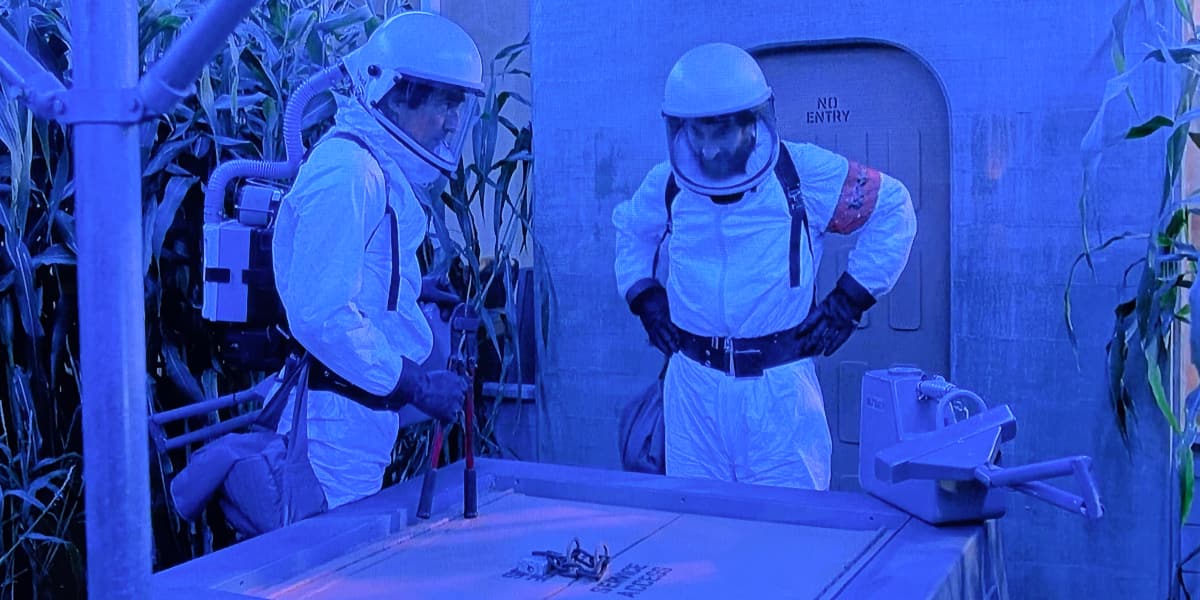
At a remote agricultural biochemical facility, a group of scientists are celebrating a discovery, but while taking a photograph a vial is accidentally broken and the whole building is immediately shut down. Government forces arrive to manage the incident, confusing the people of the town who don’t know the facility’s true purpose. Sheriff Cal Morse knows his wife is trapped inside and decides he has to try to get her out.
It moves quickly, and the first half is a particularly intriguing blend of The Andromeda Strain, The Crazies, and more cheesy TV movies of the time. This makes it extremely watchable. The cast is decent, and Yaphet Kotto as Major Connolly is charismatic and brings some edge to things, but towards the end it gets flabby plot-wise and too melodramatic for my taste. I was never bored though.
The story is about the risks governments take without informing the public, in this period specifically genetically modified foods and the biological weapons race in the later stages of the Cold War. I’m always fascinated by how genre films like this got made. First-time (and only-time) director Hal Barwood was a writer-for-hire, and he wrote the script for Warning Signs with long-time writing partner Matthew Robbins as a manageable project for Barwood to try his hand at directing a film himself.
It feels remarkably accomplished, even though it bombed at the box office, because he had Academy Award-winning professionals all around him, including Spartacus editor Robert Lawrence, Dean Cundey as cinematographer, and Henry Bumstead as production designer, who later worked on Cape Fear, Unforgiven and Million Dollar Baby.
I suspect the producer, Jim Bloom, played a major role in how this film came together (he's the second of the three interviews in this three-hour video!).