
April 13 2026, 14:37
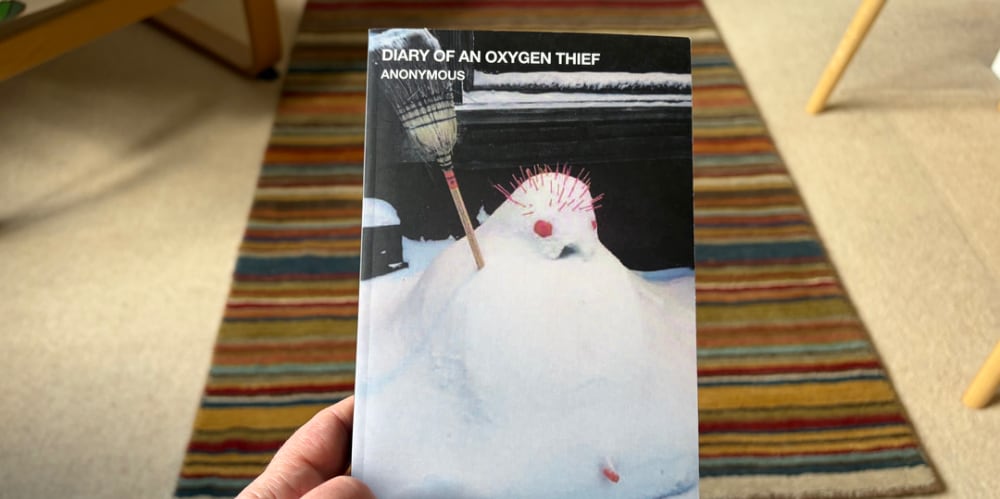
Diary of an Oxygen Thief
The question of whether it is fiction, autofiction, or autobiography colours the experience of reading this book from the start. The opening line is, 'I liked hurting girls'. The author is anonymous. And for the next fifteen pages he describes in malicious detail how he manipulates a woman into falling in love with him before dismantling her emotionally just because he enjoys seeing her in pain. I had to make a decision at that point if I wanted to continue.
It's written well. The voice is narcissistic, amusing in places (but nowhere near as funny as it thinks it is), self-aware, and dripping with self-loathing. He foreshadows a comeuppance at the end to try to make the details of his emotional abuse worth reading, as if it's all okay because revenge was had, and this is also an attempt to manipulate the reader. It worked on me, because I finished it.
The drawn out and complicated plot to professionally undo our anonymous voice is woefully inadequate compared with the many women he abused before he became sober. It's a strange story, and it comes back to the central conceit. There is art, there is the artist, but what to make of something whose origin is deliberately obscured? It could be an artfully constructed fiction. That's impressive. It could be a narcissistic damage limitation exercise by a terrible person. That's something else altogether. It seems to me that the Anonymous moniker only serves the commercial interests of the publisher.
April 05 2026, 15:13
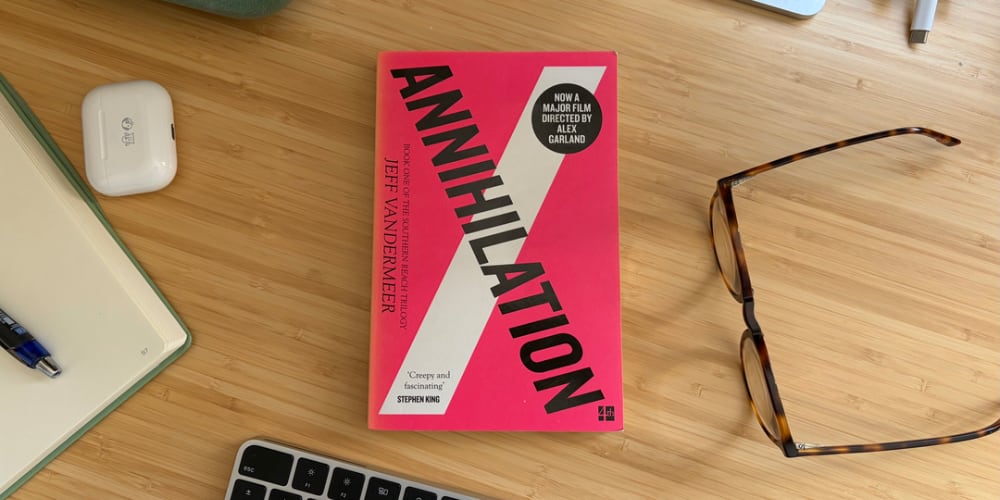
Annihilation
I don’t reread books in general, just as I don’t rewatch films. It’s not an impulse I have. I'm not a comfort reader. There are far too many things in the world that I’m yet to read or watch, and the older I get the more I feel that time is speeding up, so it needs to be a strong gut feeling for me to go back.
With Annihilation, I remembered reading it in 2017, before the film came out, and I remembered the excitement and awe I felt in the details of Area X, and how the story’s central mystery captivated me. I wanted to read it again as a writer. I wanted to understand the techniques that made it work.
Five people are chosen by the Southern Reach, a secretive government agency, to travel to Area X, a mysterious coastal land somewhere in the United States sealed off from the outside world. Each has an area of expertise—biologist, psychologist, surveyor, anthropologist and linguist. In their training, they are told not to reveal their names to each other, and the secret mission is to find a previously established basecamp and investigate the area with their various skills. It quickly dawns on them that they have been deceived about the nature of Area X.
The first thing I noticed was how rich the description was. It’s written in first person from the perspective of the biologist, so she knows the names of all the vegetation and spots the patterns in nature, and she is the first to be suspicious of what’s happening biologically in Area X. The mystery is deepened further by her backstory, which she reveals gradually, and the weird power dynamics playing out in her team. VanderMeer’s economy of storytelling is exemplary. Major events are described matter-of-factly through the biologist’s studious gaze. She is the purest scientist in the team, and her ability to see clearly the group’s dramas makes for a lean, fast-paced read.
I don’t want to say much more about the plot. It’s become on second reading one of may all-time favourite novels. It’s inspirational how so little prose can communicate so much about a character’s inner life while they undergo cataclysmic events in their outer environment. There are many ingenious plot seeds that flower into weighty moments later in the story—the journals each character is asked to write in, the tower going into the ground—if you read it, you’ll know. Read it!
March 15 2026, 18:04
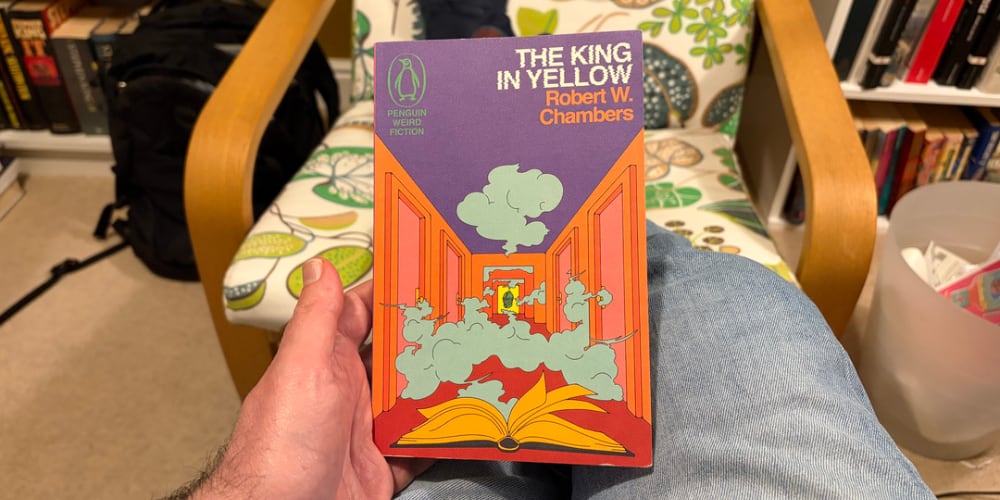
The King in Yellow
Five short stories. A book in the Penguin Weird Fiction collection. The original has ten stories, so I’m guessing an editor at Penguin chose the “most weird”. The King in Yellow is also the name of a book referenced in some of the stories reputed to send whoever reads it insane—it describes an ancient city called Carcosa, shone down on by black stars, near the Lake of Hali, and mentions a symbol called the Yellow Sign.
Chambers’ stories are thought to have been an inspiration and reference for later writers like H.P. Lovecraft and George R.R. Martin, and I can certainly see how that could be true. He spins the ideas of other worlds with just enough detail to make them feel tantalisingly real, but the stories are mostly tied down with realistic detail and strong character voices.
The opening story is the longest, The Repairer of Reputations. It follows Hildred, a wealthy man in a future version of New York where the United States has conquered the western hemisphere while Russia controls the east. Hildred reads The King in Yellow and comes to believe he has royal blood from the kings of the land of Carcosa. A mysteriously knowledgable Mr Wilde stokes the madness in Hildred and contrives a conflict between Hildred, an armourer friend, Hawberk, and Hildred’s cousin Louis, who is fresh back from military service. Things spiral marvellously out of control. It’s a fascinating descent into madness.
In contrast, The Mask is a gothic love story with an unexpectedly emotional ending, showing the range of Chambers’ talents. I think that was my favourite. The Yellow Sign takes us back into horror, but also revels in the daily life of an artist and painter, Mr Scott, and his favourite model, Tessie. I loved how rich and full of life these stories felt.
The last story that feels like a story is The Demoiselle d’Ys, a time travel love tale, because the final one, The Prophets’ Paradise, is more a collection of snippets—strange looping puzzles that are hard to make meaning of, almost as if they were taken from the pages of The King in Yellow.
February 26 2026, 21:08
Scanners
I’m learning acoustic versions of pop songs on guitar. I asked my teacher to help me get better at picking out chords and keys and rhythmic patterns. Music has my attention.
UltraSky, Alison Goldfrapp (composed by Alison Goldfrapp, Richard X & Stefan Storm—are these real people?). New Rules, Dua Lipa (composed by Caroline Ailin, Emily Warren & Ian Kirkpatrick). Songs are written. It’s an art I haven’t thought much about, although I did buy Tunesmith: Inside the Art of Songwriting, by Jimmy Webb, when it came out twenty years ago, and I went through a few half-hearted periods of buying music paper and sharp pencils.
I’ve always had these bursts of enthusiasm, but I thought I had to choose one thing, so I’d let these hobbies burn out. Looking back, there are repeating enthusiasms. Music is a foundation interest. Creative writing. Then there’s cooking, languages (mostly German), films (film-making? why not!) and tennis... I’ve rotated between them all several times.
Coding brings home the bacon, and I think I’ve taken creative writing the furthest outside of work, probably even further than tennis, and I was an excellent club player. (I stopped for Covid, the arthritis caught up with me, and I could probably play again, but I also know my physio is right, I should stick to the gym and bike.)
Barbara Sher wrote a wonderful book called Refuse to Choose. It’s about a group she calls scanners, people with multiple interests and a need to try different things, whether one thing after another (sequential scanners), or several things at the same time (cyclical scanners). She proposes tools, life models and strategies to help scanners feel fulfilled in a world that traditionally expects you to do one thing well.
Ambition is tricky to manage when you are someone who wants to do multiple things. Everything takes more time. People are less likely to take you seriously. There’s a danger you don’t take yourself seriously. And if you’re older, the life clock is loudly ticking. Validation through some sort of external success can feel essential.
But there’s a great prize in going wide and less deep. A personality that is energised working in many areas will feel stifled if they don’t. One of may favourite ideas in the book is of a scanner finding the nectar in a project, like a bee with a flower. Once you’ve got what you need, move on. Celebrate the nectar. Find another flower. Maybe a different type of flower, maybe the same type, but follow intuition.
Okay, this might sound kooky to some, but if you’re like me, this could be music to your ears. With patience and faith in your unique creative process, you can connect different art forms in interesting ways, and they will feed on each other, intertwine their roots, and create something unlike anything else.
Your work will be unlike anyone else’s, nuanced and complex and interesting through your unique approach. It might be unsuccessful commercially. It might take a long time. There will undoubtedly be periods when it doesn’t make much sense. But I’m coming to realise that’s the work I want to do. That’s the fun bit.
February 21 2026, 17:26
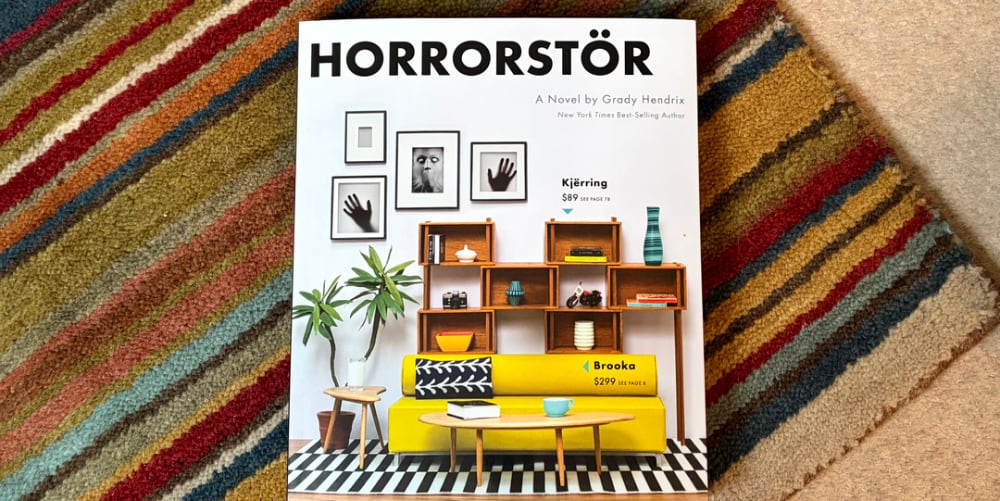
HORRORSTÖR
Sucked into a purchase by the ingenious cover design and the way it’s laid out like an IKEA catalogue, even though I’ve tried two other Grady Hendrix novels and not liked either of them, I was hopeful this one would be different. Tonally, his voice is the same, which is light, snarky and unafraid of a joke, but in HORRORSTÖR I’m more forgiving of it. I think it’s because of his likeable/relatable protagonist, Amy, and his heartfelt criticism of corporate consumer culture.
Amy works at ORSK, an American version of IKEA, but she isn’t earning enough money to pay her way in the world. She thinks her officious manager, Basil, is looking to fire her, but one night he asks her, along with older co-worker Anne-Marie, to stay overnight to catch someone who is making a mess of the store. Two other co-workers, Matt and Trinity, sneak in with camera equipment because they think the store is haunted. They discover a sixth person, Alan, who is homeless and sleeps there, and think they’ve found the culprit, but this ORSK outlet was built on the same location as the destroyed Cuyahoga Panopticon, a controversial nineteenth century prison that tortured its inmates to death in the name of salvation.
The warden of the prison, Josiah Worth, built a basement with an array of truly awful torture devices, and when his “penitents” surface at night, the past and present merge into a disorientating new reality. Each chapter is opened with an illustration of a piece of ORSK furniture, and by the time the torture starts, the chairs and beds match the gruesome designs of the Warden who thinks working (to death) is the only way to cleanse the soul.
It’s cleverly done, and there are plenty of amusing comparisons with modern working conditions spelled out, but I don’t think I’ll ever be a fan of Hendrix’s voice, even if I thought HORRORSTÖR was pretty good. The torture descriptions are nasty. Sometimes the scenes of characters moving through the store at night feel like the Silent Hill video game. The true horror seems to the temptation Amy feels to give in to the cult of corporate work and become a zombie worker. I think most people can relate to that.
February 13 2026, 21:47
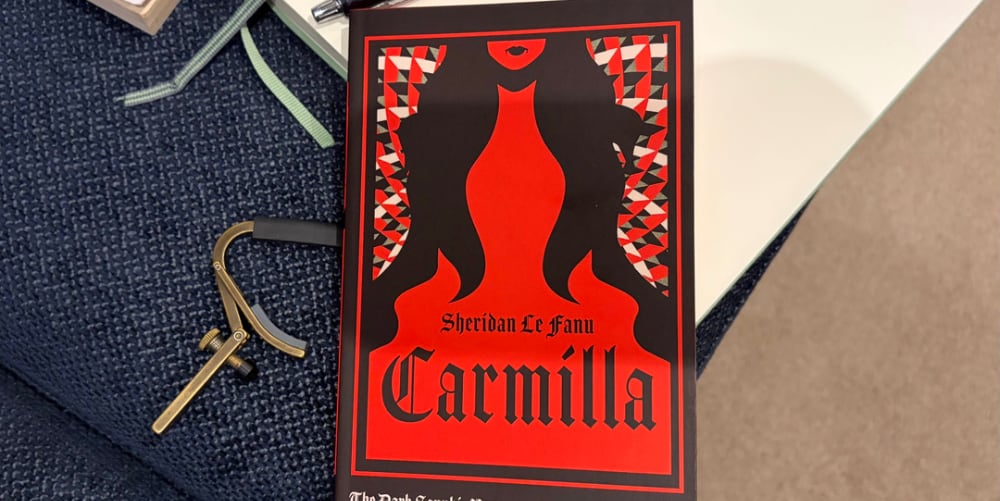
Carmilla
The book has a beautiful, striking cover with a red fore-edge, so in the bookshop I was already intrigued, but then I read the blurb claiming this vampire story pre-dated Dracula by twenty-six years, and I was sold. It’s short, originally serialised in a magazine, around 35,000 words. It’s written as a first person account by a woman named Laura which is found by a doctor with a colleague’s note attached. Her symptoms are thought to be supernatural.
Laura and her widower father live with their servants in a remote castle deep in a forest. One day a carriage passes with a mother and daughter aboard. Laura is lonely, and the mother asks if her daughter, Carmilla, can stay with them for a few months while she performs a vitally important errand. Laura and Carmilla strike up a strong bond, but villagers in the surrounding areas begin to die from a new disease, and soon Laura is suffering from a more drawn out version of a similar malaise.
It has fairy tale elements to it. In fact, it’s pretty Gothic. They live in a castle, everything feels ominous, and emotions are heightened. Laura is torn between love and disgust over Carmilla’s intense feelings for her. The lesbian vampires that emerge in the sixties Hammer films could have their roots here. Laura doesn’t seem to be sexually attracted to Carmilla, but the intimacy is used by Carmilla to create her vampiric bond.
Laura has a dream as a child of a creature in her room that bites her breast, and when Carmilla arrives Laura recognises her from the dream. Towards the end of the story we discover the vampire family’s home is in the same forest, so the ever-young Carmilla probably preyed on Laura twelve years before, although that isn’t explicitly said. Like F.W. Murnau's film Nosferatu (1922), the vampires in Carmilla spread death quickly and widely, like bubonic plague. A devilish creature indeed.
February 09 2026, 20:17
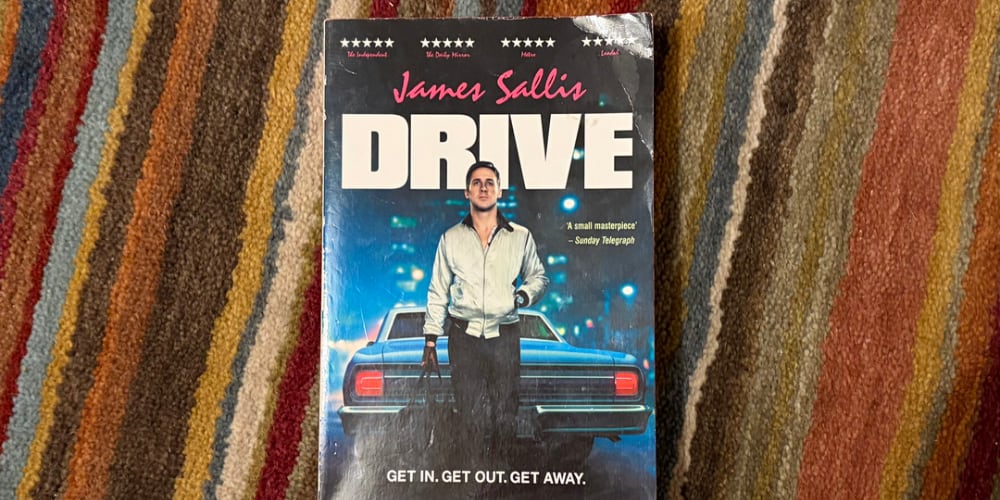
Drive
A short novel, around 45,000 words. We follow the literally-named Driver, a stuntman starting a career in Hollywood who instead chose a life as the getaway driver for armed robbers. The story jumps artfully around Driver’s whole life, concentrating on a job that goes wrong and the fallout from it, but also spending lots of time in the minutiae of life in Los Angeles in what seems like the eighties. It’s a timeless setting. The only clues are the lack of mobile phones, the many film references and the model years of cars Driver steals for work.
This 2006 novel is an expansion of a short story Sallis wrote in 2002, and my copy of the novel has Ryan Gosling from the 2011 film adaptation on the front—so that’s three versions, followed by a sequel Sallis wrote in 2012, Driven. He held on to this character for a decade or more, even though there is very little to know about him from the page. That’s interesting. Driver is a kid with a rough upbringing fleeing to Los Angeles to try and make a life doing the only thing he’s good at. He’s a character that could easily be a cliché, but instead holds the reader’s attention through the voice Sallis uses to tell the story.
The point of view switches when necessary for the plot, and that keeps things interesting. We briefly see the world through the eyes of underground medic Doc, incompetent mafioso Nino, and the more accomplished killer Bernie Rose. There are friendlier characters with names like Standard, Manny and Shannon.
Manny is a rich screenwriter living in a rundown house who takes Driver out for expensive meals to talk literature. I wonder if he’s a proxy for Sallis himself. Driver eats a lot of meals which are described in great detail. These men love to eat well in their otherwise grotty lives. The sentences and characters are noir to their bones. A refreshing read.
January 31 2026, 20:17
Winter refresh
I’m juggling projects and I’m enjoying myself. Over the Christmas break I decided to give in to my nature and do what I want when I want (creatively speaking). I can only do this when I’m relaxed. In the past, trying to live this way, the snake of anxiety always reared its head.
Not this January. Without wanting to tempt fate, something seems to have changed inside me for the better. I want to make things, and I want them to be good, but I’ve stopped worrying about their impact on the world.
I’m working on the novel. I’m still having guitar lessons, and I’ve been challenged to write a song. I’m going to the cinema to see new films, finding new music to listen to, reading new books. I’m cooking new meals. I’m taking photographs when I’m out and about. It’s a new year, I’m not a new me, but I do have a fresh mindset that’s sticking.
It’s always seemed to me that my creative impulses were part of a cohesive whole—an identity that I couldn’t easily label but felt real. I’m experimenting with that identity. No judgement or expectation.
I’m doing what I can to keep my timeline aligned with my true interests. Not bullshit politics or tragedies thousands of miles away I can do nothing about. If I can do something, I will, but I’m refusing the attention black holes.
I’ve stepped back from reading Bluesky and I’m avoiding the news as much as I can. I post a couple of times a day and read the people on my Bluesky ‘good list’. I have a Bluesky alt that follows some small art, horror and ‘demure erotica’ accounts (yes, I made that term up, but it should exist).
Online can be light and fun. My life is lighter and more fun. I’m far more concerned about having a creative life than being seen to be successful in all the usual ways. I’m excited for February.
January 27 2026, 22:30
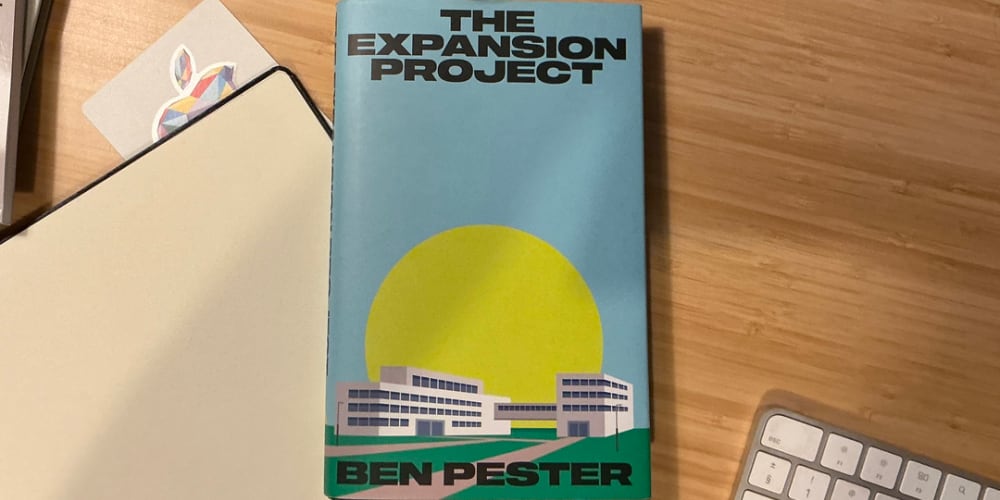
The Expansion Project
Tom Crowley, first person, then others, ~60,000 words.
There are pleasures in work, but also drudgery, especially in larger organisations where there’s a tremendous amount of bullshit to navigate. Tom Crowley is a workaholic who struggles to connect with his children and feels overwhelmed by guilt at his inadequacy in all areas of his life. He takes his young daughter, Hen, to work (for Take Your Daughter to Work Day) and discovers that nobody else saw that email, so there are no other children for her to play with. Then she goes missing.
Tom works at Capmeadow Business Park as a copywriter. At the start of the story, Capmeadow seems concrete enough, expanding with new buildings and projects, but there is a mysterious mist, and people who work at Capmeadow are often confused and anxious about things they can’t quite put their finger on. Their minds play tricks on them, and the longer they work there, and as Capmeadow grows, the expansion becomes more abstract, surreal and upsetting.
An archivist interjects the narrative with notes about the text, which are recorded as part of interviews with the characters over a long period of time. Capmeadow seems to be an organic, living thing, perhaps alien, or a virtual reality, or something else, and anyone who’s worked there seems to be pulled into its growing madness.
Tom Crowley is the closest to a main character we have, continually showing up in the archivist’s records searching for his lost daughter. For him, work is so entwined in his daily life, he succumbs easily to Capmeadow’s spell and work becomes his life. He wanders Capmeadow’s maze of rooms, corridors, gardens, Kanban boards, online calls and chatrooms as if they were all as real as each other.
It’s a tale of how work identity can become our only identity, working on meaningless tasks for empty projects, until we dissolve into a now-sentient capitalist organism. Disturbing more than amusing, it's an impressive surreal dystopia that feels like a warning shot across my bow.
January 13 2026, 21:01
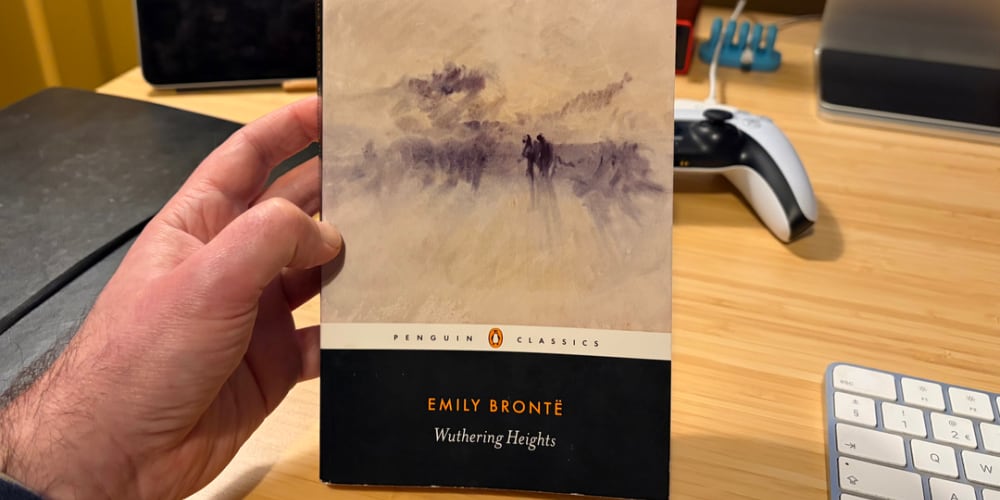
Wuthering Heights
Mr Lockwood, via Nelly Dean, first/second person, ~200,000 words.
I didn’t finish Wuthering Heights. I got about a third of the way through before I became stuck in the sludgy swamp of the prose and subject matter. I picked it because I saw a trailer for the upcoming Emerald Fennell adaptation in the cinema, and also it was my mother’s favourite book—I have a copy signed by her from childhood—so I gave it as much leeway as I could manage before the relentless misery and suffering snuffed my energy for it out.
The book is not at all the romantic story culture has made it seem like. The various adaptations play on doomed romance and star-crossed lover tropes that are just not in the novel. Heathcliff is violently abused and becomes monstrous. Cathy is a narcissist. As young stepbrother and stepsister, they are terrors around the house, rude to everyone and unpleasantly mischievous.
In the opening scenes, the hapless Lockwood goes to Wuthering Heights out of curiosity and is met with a dilapidated house where he is denied entry, mocked by owner Heathcliff, attacked by his dogs, refused a place to sleep when a snowstorm hits, and eventually given a chair in a haunted room. It's a relentless exercise in discomfort. Undetered, the nosey Lockwood encourages his landlady, Nelly Dean, who used to work at Wuthering heights, to tell the story of how Heathcliff came to be as he was. We learn Heathcliff was a rescued orphan, bullied by his jealous stepbrother, Hindley, and besotted with his kindred-spirited stepsister, Cathy.
The story turns on an incident where both children play a prank on a neighbouring house, home of children Edgar and Isabella Linton. Cathy is hurt and taken in for several weeks to the Linton household where she is taught the manners and fashions of a lady. Heathcliff is blamed disproportionately for the prank and is punished harshly, so when Cathy returns Heathcliff has become almost feral, and this schism in their relationship eventually becomes permanent.
Throughout his childhood, Heathcliff is brutalised and blamed for much that is not his fault, so it makes sense that he would want revenge. As the book went on, I began to realise that his behaviour was so abhorrent and sustained that there was going to be no redemption. Cathy’s behaviour was repellent in different ways. I kept getting confused with people’s names, jumps in time, genealogy, property law—it was a hard book to follow, and the events told were consistently unpleasant. It was beginning to make me feel miserable (and not in a good way!), and I began to avoid reading it.
So, I read the synopsis on Wikipedia, and seeing where it was going, decided to call it a day. I'm not sorry I missed out on the vengeful sadistic marital abuse. I’m glad I gave it a go. I certainly have a decent knowledge of the story and characters, so I’m marking it as read and moving on.