
December 14 2025, 10:59
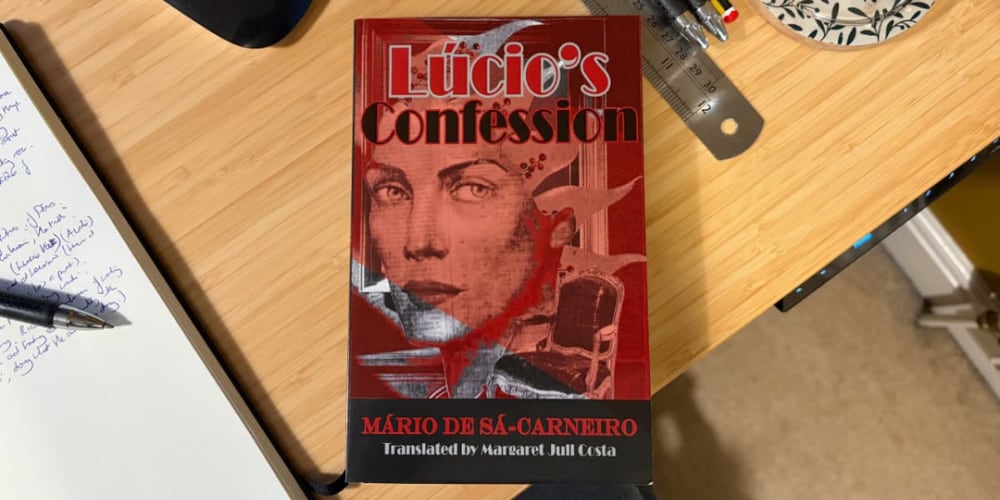
Lucio’s Confession
105 pages, 8 chapters, ~38,000 words
I bought this while visiting "the oldest bookshop in the world", Livraria Bertrand in the Chiado district of Lisbon, at which the staff stamp the inside cover in a cute proof that it was bought there. There was a small English-language section, and only a handful of books by Portuguese authors translated into English. This one jumped out at me because of the red cover, suggestive blurb, a quote from The Sunday Times describing it as “a thoroughly decadent story of an unusual menage à trois which ends in a killing”. I mean, of course—I’m in!
Lucio Vas is a writer in Paris in 1895, enrolled to study Law, but instead mostly hanging out with a charismatic poet, Gervásio Vila-Nova. Through a series of social encounters, Lucio meets Ricardo de Loureiro and strikes up a strong friendship. Ricardo suddenly returns to Lisbon, and after a year of little contact, Lucio follows him, only to find that his friend has a new wife, Marta. The relationships between Lucio, Ricardo and Marta become murky as Lucio embarks on an affair with Marta that seems to be with Ricardo’s consent.
The novel is framed by the idea that it is written as a confession by Lucio after serving a ten year prison sentence for a murder he claims he didn’t commit, but at the same time didn’t defend himself against the charges. We come to see that Lucio suffered some kind of mental health crisis once back in Lisbon and in contact with Ricardo again, who alludes to being homosexual, unable to feel love, and yet perhaps in love with Lucio.
Romantic or sexual love between two men was socially impossible at the time of the book, and Lucio constantly questions whether Marta, who he has endless sex with, really exists. Lucio whips himself into an emotional frenzy, and at the denouement, it is still unclear who was shot in reality. Perhaps to be published, that final reveal needed to be kept as an implication, although it goes further and doesn’t allow Lucio any clarity, and he remains with the impossibility of his experience to the end.
Previous: Warning Sign | Next: Reflection in a Dead Diamond