Blog
It feels like a small act of resistance to publish a blog these days. It’s a quiet place on the internet with a domain name I own, away from algorithms and the ever-updating news. This is a static website built with Eleventy, which keeps it secure and fast, but also means it’s not like Wordpress—there are no comments or likes on posts, which frankly is a relief.
June 03 2022, 15:45
Kindness in retrospect
I’ve always thought that living life well was more important than writing, and typing that aloud I’m not sure if that sounds obvious, wise or stupid. I know writing regularly is part of the life I want, but often life events sweep away my desire to write, and trying to write under those circumstances results in needless suffering. My internal critic says I’m being lazy, or disorganised, or just not up to the job, but kinder voices reassure me that there is a season for all things.
My day job has been particularly tricky the last twelve months, a pressure built inside me to make a change, and to do a good job of that change required effort. It wasn’t planned in much detail, and it’s only clear what was happening looking back. The next bit of work is managing the transition from here to there. I’m being deliberately vague. I couldn’t write at the same time, that’s what I’m saying. It’s kindness in retrospect.
Last weekend I went to Chillercon, Scarborough, and I met lots of lovely people, which led to me buying even more books. More on that soon.
April 15 2022, 16:28
An oblique strategy
I’m in Wales with my dad today, Good Friday, taking him for a Covid test before he has a cataract operation Monday. He’s been waiting six years to get both eyes treated, and he’s worried something will happen to cancel it, which has happened several times already. I head home tomorrow and my sister takes over the ferrying around. I’ve had Covid this month, and my wife still has it, so I could do with a couple of days at home to settle my mind and reconnect with myself before I start back at work on Tuesday.
Sunday will be my tenth podcast on Patreon, so that’s ten weeks of learning how to speak clearly, record my voice, listen to my voice (which was uncomfortable to begin with), and think on my feet in front of a microphone. Of course, it’s just me, I’m not interviewing someone or in conversation, which is something else again, but I’ve learned a new skill. Part of the point was to offer something personal to patrons. Patreon doesn’t provide analytics, but from the lack of feedback, I suspect hardly anyone listens to it. Ten is a nice round number, so I’m wondering if that’s a good place to pause and think of something new to put on Patreon, or at least plot a new course for the podcast.
I’m using Twitter less, partly because I need to avoid the news since Russia started the war with Ukraine, and partly so that I could make more time to read books to talk about on the podcast. It’s an oblique strategy to get me reading, and from there to get me writing. My online activity starves me of literature while stuffing me full of semi-connections with distant people. All of this makes me think about the relationships between a writer, readers and other writers. The bottom line is, I need more in-person activity.
(I put up a Twitter poll about making a public podcast and amusingly half of the respondents said there were already enough podcasts. I don’t know why I asked, because if I do it, it will be for myself, not other people. Vanity, I suppose. Or I was fishing for compliments. Either way, it was a lesson in humility.)
I’m looking forward to the weather getting warmer. There’s a lot I want to do, and sunshine and warmth helps. Now that I’ve had Covid, a weight has lifted that I didn’t know was there. The monster wasn’t as fierce in my body as I’d feared, and I have at least a season’s grace. I’m excited for the spring into summer.
March 06 2022, 09:01
Patreon: one month in
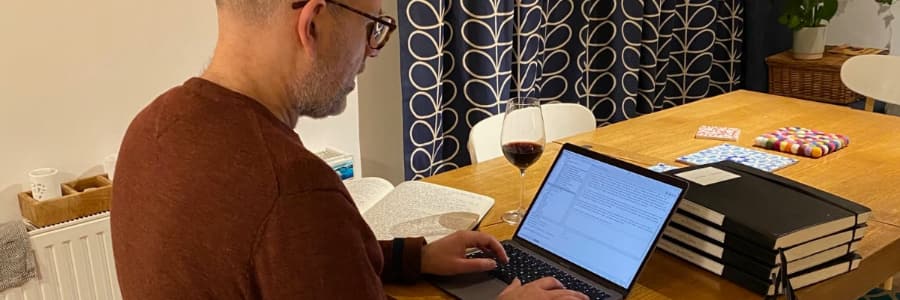
It’s been a month since I set up a Patreon creator account and started posting a few things only for patrons, and it feels like a good time to stop and take stock. The initial idea was to explore publishing short stories behind a paywall, to try to motivate myself to finish smaller pieces because there was an expectation, and to put a symbolic stake in the ground that said, I want to have some control over when I publish my work, and, no matter how little it might be, I want to be paid for it. Alongside that statement of confidence, I was full of self-doubt, and deep down I knew there was no way I could publish short stories that often and still finish the novel.
I wasn’t planning on starting a podcast, but that’s what I’ve done. I found YouTube videos about getting started, then spent a hundred quid on a microphone, which is a bit mad for a gut feeling, but really a microphone is the only expense in doing it, and I didn’t want to have to listen to my own voice at all, never mind in terrible quality audio. The first recording was a test, just thirty seconds, to prove I could go from talking into a mic to seeing something appear on the web. I published three more episodes (episodes!) of the show (the show!) in February, trying something new each time and building confidence.
I’m still not sure what its purpose is, but if I had to say right now, it could be a meta podcast about my creative life for people who want to support me and my work, and I can imagine a public parallel podcast in the near future that is more formal, and perhaps linked with my next book.
All of that is very different to the initial idea of publishing short stories. I have a handful of glorious patrons, most of whom have implied that they are supporting my work, whether for one month or many more, and not necessarily expecting anything in return. Capitalism trains us to think in transactions, to get something for our money, but a patron isn’t necessarily thinking that way, which is a beautiful reminder of the human desire to connect and help others, independent of the market.
Having said that, I do want to give people who support me something back, and the private podcast is the first thing. I’m now thinking what else I can do. I can certainly put them in the Acknowledgements of the next book, and no doubt more things will come to mind over the spring and summer. I put too much pressure on myself to finish things, substantial things, not just tweets and blog posts, and that severely hampers my creative energy. Working full-time makes time feel scarce, but the kids are getting older, the pandemic is easing, and I no longer commute. I can feel the writing knot inside me (dont call it writers block dont call it writers block dont call it writers block) loosening. I’m excited to find out what happens next.
February 06 2022, 10:39
Writing short stories on Patreon
I’m thinking about what people might like to see in a writer’s Patreon, and what would be exciting for me to publish. My favourite Patreon creators are podcasters, and of course they give access to extra podcast episodes. Creating a podcast might be fun, but I am primarily a writer, so my crazy idea (crazy for me, knowing how I usually write stories, i.e. slowly) is to publish a short story a month for the rest of 2022 on Patreon. These stories do not exist yet, so it’s a commitment to publish something once a month that is edited and complete, not just fragments. From nothing to ten stories in ten months.
A book of, say, a dozen short stories might cost a tenner, of which the author would get, after all the other costs are taken out, fifty pence. If it sells a thousand copies, which would be really good going, that’s £500 for more than a year’s work. There is also money from library loans, which could be another £50/year. I received half that for The Complex in 2021.
There is no money in the publishing industry for the vast majority of writers. There is barely enough money for independent publishers to stay in business. Looking at it with a couple of years’ experience now, the model is broken for all but the biggest publishers and the authors those publishers put their marketing muscle behind. There are so many people writing these days, and there is so much ‘content’ (bleurgh), that authors are on their own, in marketing terms. Now I can see why some writers self-publish. Before Salt picked up The Complex, I was sceptical. If anyone can publish, how can I find what’s good? Who are the gatekeepers of quality that I trust?
I suppose I’m talking around the fact that publishing short stories on Patreon is a form of self-publishing, and if I’m going to try this, I want to be clear with myself and whoever subscribes about what I’m aiming for. I need to think carefully about that.
January 22 2022, 18:18
Films, dreams, fiction and writing
I’ve come to think that films are intrinsically linked to my writing practice, but I’m worried my film-watching habit is more of a distraction than an inspiration. Films are like dreams, and the good ones are endlessly interpretable vessels for the unconscious mind. How could that not be useful to a writer? Or am I kidding myself?
What I really want is to discover films and fiction that directly feed into writing my work-in-progress. When I pick a film, sometimes it’s based on an unconscious desire or feeling that needs surfacing, and often it’s linked to the last thing I watched or read, perhaps an actor, or a theme. Even bad films have something for me, a single image or a line of dialogue. If I paid more attention, maybe I could use films more actively in my writing. The scenes I write look like a film in my imagination. Well, rehearsals on a film set, let’s say, with a sparse, mostly improvised script, a confused director, and infinite film for lots and lots of takes. Sometimes details from films I’ve seen will slip in, and an unseen costume designer will amend an item of clothing, or a casting director will change an actor’s face. Dreams definitely get added too. Dreams are like surreal short films loaded with my deepest desires and fears.
What I’m saying is, I want to better understand how films, dreams, fiction and writing are connected. I hope I can make watching films a more conscious part of my writing practice, but perhaps my film habit will turn out to be more of a drag than inspiration. I don’t know. I want to experiment.
December 30 2021, 21:15
Farewell, 2021
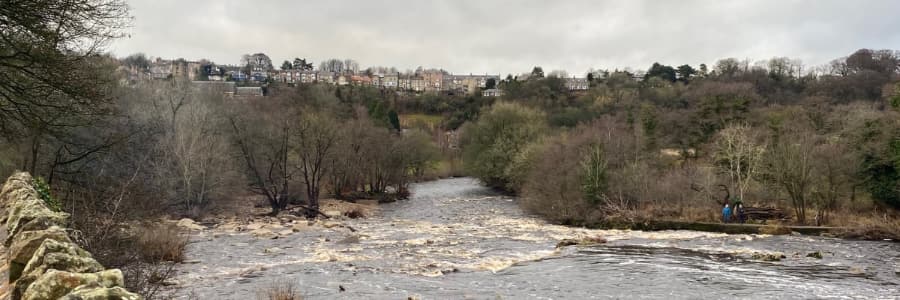
As 2022 comes into view upriver, the final days of 2021 flow past, and I couldn’t pass up the chance to reflect on what I’ve read, watched and written this year. (Okay, reflect is a strong word, but it’s been a difficult Christmas, and I’m very tired.)
In books new to me, I opened the year with Ali Smith’s wonderful Autumn, and if my favourite books are like stepping stones on this river metaphor I’m in danger of drowning in, from there I went to An Awfully Big Adventure (Beryl Bainbridge), The Cost of Living (Deborah Levy), Clothes, Clothes, Clothes... (Viv Albertine), Redhead by the Side of the Road (Anne Tyler), Boy Parts (Eliza Clark), Hotel du Lac (Anita Brookner), The Shooting Party (Isabel Colegate), and The Glass Hotel (Emily St John Mandel).
I’m not much of a re-reader, but I got caught in some reading ruts this year, and I found writerly solace in returning to Joyland (Stephen King), Annihilation (Jeff Vandermeer), and Tinderbox (Megan Dunn).
Films. Oh-so-many films. Out of [165 films watched in 2021(https://letterboxd.com/michaelwalters/films/diary/), I gave 39 of them a rating of 5/5, and of those, my top 10 favourite discoveries, in chronological order of being made, are:
- Blow-up (1966)
- Performance (1970)
- Klute (1971)
- The Long Goodbye (1973)
- Blue Velvet (1986)
- Lost Highway (1997)
- Triangle (2009)
- Riders of Justice (2020)
- Pig (2021)
- Dune (2021)
And because this image blows my mind, here are all 165 from Letterboxd, in reverse order of watching:
Finally, in my writing, I started the year with 25,000 words of a new novel, and I end the year with 22,000 words of a new novel. But I’ve already written enough about that.
December 05 2021, 13:52
The great adjustment
Between January 2018 and December 2021, I watched 569 films. I know this because I track the films I watch on Letterboxd. That’s a lot of films. Not as many as more serious cinephiles, but a tremendous amount for someone who actually wants to be a novelist and not a filmmaker. I‘ve watched 157 films this year so far, which is on average fifty minutes a day, the length of a session of psychotherapy.
There was a gradual increase—2015 (11), 2016 (34), 2017 (61), 2018 (140)—and it’s linked to submitting my novel-as-dissertation in September 2017. After that, I needed to get away from writing, so I discovered horror film podcasts, and started a completely different adventure. I told myself that it was useful, which it was, to understand how the great (and not-so-great) films worked, thinking about story, narrative, dialogue, character arcs, all that good stuff, but looking back, I should have disengaged earlier and brought that knowledge back to my writing.
When the pandemic hit, and I was stuck working at home in a new job, with a constant newsfeed of virus fears, Trump and Brexit, I doubled down on films as a coping mechanism. (I know I keep going over this, but I think a lot of us are going to be dealing with a form of PTSD around the pandemic experience for some time to come.) I stopped reading for pleasure, partly because I lost my commute, and partly because I could feel a pressure building in me to be writing the next thing. I could watch a whole film in a ninety-minute evening slot and tick it off a list, but a novel was a longer undertaking, over several days, taking up valuable headspace that I could be using for writing. I would pick up a book, and quickly have to fight the urge to scan it, study it, and jump to the end. This was reading without engagement. I was still reading novels, but in a begrudging, desperate, manic, miserable way.
Films made me feel better in the world. Books made me feel worse. Films immerse you through image, sound, story and the fact you have to watch it for as long as it lasts, like a fairground ride. This intensifies the experience and heightens emotions, so it is closer to real life. I love that. But reflecting on a film is hard while you are watching it because it is still happening to you. It’s quite an invasive experience. It can feel overwhelming.
Books, on the other hand, give the control to the reader. A reader can be distracted by a knock at the door, read sentences a second or third time, look out of the window and daydream, recall a memory, read faster or slower, skip over a stressful scene, or even read the ending first. They can make notes in the margins and write in a notebook. You are immersed in the world of a book, but the book doesn’t demand your undivided attention. Books are a very forgiving companion. (I heartily recommend the chapter on reading in The Art of Rest, by Claudia Hammond.)
Here’s the heart of the matter for me: I can’t write without reading. To write, I need the written word as nourishment, and for me to feel nourished, I need to read slowly, with curiosity and my mind engaged.
This realisation, which is completely obvious on the surface, arrived because, in thinking about 2021 and what I might do differently in 2022, I looked back at the books I had read, and the films I had watched, and knew there needed to be an adjustment. I’m out of balance in how I get my story fix.
After four years of my adventure in films, I’m starting the great adjustment—fewer films, more books, and getting reacquainted with the gentle art of reading.
November 27 2021, 21:16
Keeping the story alive
Feeling the pull of Christmas, and seeing 2022 on the horizon, I’m looking at my work-in-progress, and it seems to be asking how we got here. It’s a patient and wise creature. It knows I haven’t said anything about it to anyone, bar its name to a very select few, perhaps out of superstition, but also, I think, to keep the energy it holds close to me, to nurture it, and show it I am taking it seriously. It’s not fodder for polite, or impolite, conversation, and certainly not to be talked about on Twitter.
The glimmers of this story coalesced in February 2019, while I was working on final edits for The Complex, where all I knew was that it was going to be told over several locations that I had dreamt and sketched on a map, it had a title, and most intriguingly, a revealing phrase about the protagonist. I was in a particularly manic phase of my life, because my day job was busy, The Complex wasn’t finished, and to self-soothe, I was watching way more films than was good for me. Ridiculously, I was also trying to learn German. My mind was leaping around like a loon, but I kept redrawing the map, came up with some character names and a couple of grand metaphors, and thought about character motivations. This was all between doing other life things. No draft words were written. These were just ideas I kept coming back to, with some occasional sentences in my notebook.
As an aside, I find free writing to be an essential creative writing tool, where you write without censoring yourself for twenty minutes or so. Another is writing conversations with characters in an imaginary theatre space, both as characters and the actors playing them. You can get them to rehearse with each other, improvise, and so on. Great for when you're stuck.
Right, back to the story of the new story. For me, this is where it gets interesting. In my head, I had been telling myself that all through the second half of 2019, with The Complex being published, I was in marketing mode, spending way too much time on Twitter, asking for endorsement quotes, organising a book launch, looking for opportunities to talk in public, and all that necessary stuff. Looking back at my notebook from the time, in fact I continued to work on the new story all through the autumn, adding layers to the characters, changing their names, lightly researching the things they were into, drawing and redrawing the map, cutting out photos from magazines, and continuing to build up the world. I suppose I thought I wasn’t working on it because, looking back, there was no tangible progress, no words in a draft, but I’m way too hard on myself. Novels take the time they need, and life had to come first.
Then in February 2020 I started a new job, and the world went a bit mad.
I kept writing in my notebooks. I wrote a short story, Signal, which was published by Nightjar Press. Work was incredibly challenging, both kids were home from school, the line between work and home disappeared, and the news was full of the pandemic, Trump and Brexit. I watched a lot, a LOT, of films. It began to feel like I had writer’s block again, but I kept writing in my notebooks, and the make believe world slowly solidified.
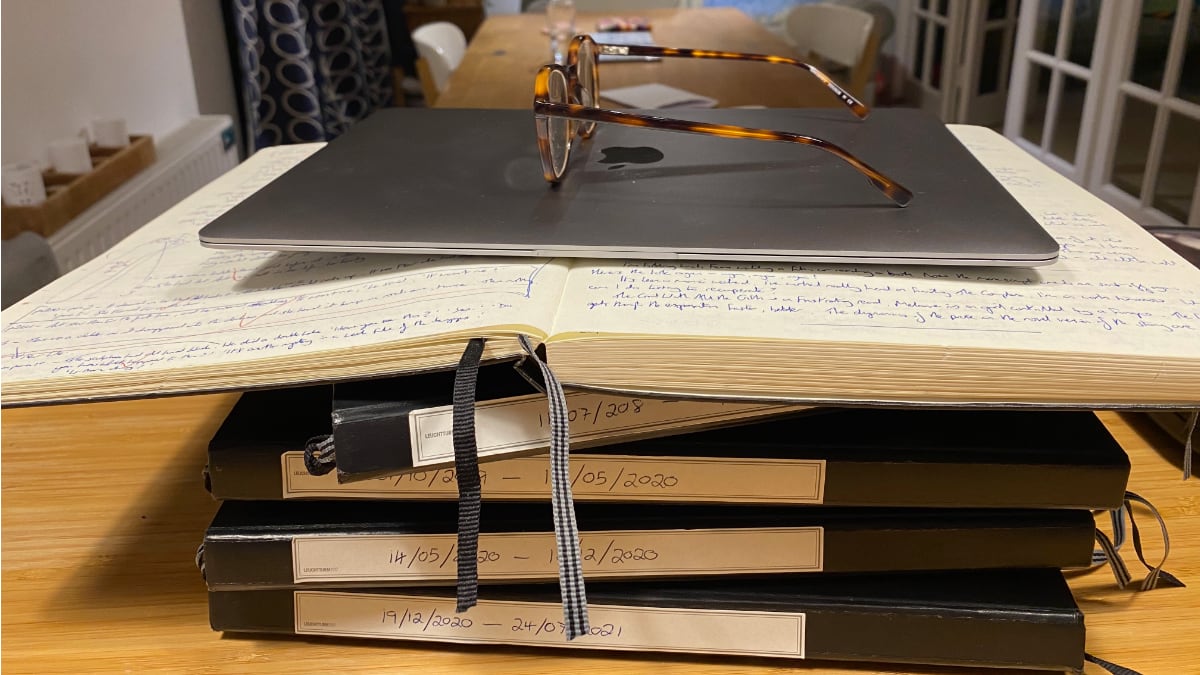
When the cafes opened again in August 2020, I began a first draft. I was up to twenty thousand words when the second lockdown hit. I got it up to twenty-five thousand by Christmas, but the third lockdown, the big one of January 2021, totally messed me up. I retreated to my notebooks once more. (I seem to need a cafe to write a draft. It’s the only place I am guaranteed no interruptions. And home is now where I do software work.) For seven more months I wrote in my notebooks. Finally, in July 2021, I went back to the beginning of the draft, and in my little Caffe Nero, every morning before work, I edited it into some sort of shape.
What am I trying to say? It’s over two-and-a-half years since I started this next novel. It’s becoming real at last. I’m praying there are no more lockdowns, but perhaps I’m too far along now, with too much momentum, for another lockdown to block me. My notebooks helped me keep the story alive through the chaos. They are also the custodians of the facts of the story’s writing, its history, because I really can’t trust my memory.
I’d like to have a completed draft by my birthday, in March, which would be three years from inception. That appeals to my sense of neatness. And if it isn’t already abundantly clear, I write in my notebook every day. That’s what makes me a writer. It’s nothing to do with word counts or being published. It’s showing up in a notebook and keeping the creative flame alive.
October 31 2021, 18:28
In the Earth (2021)
Director: Ben Wheatley
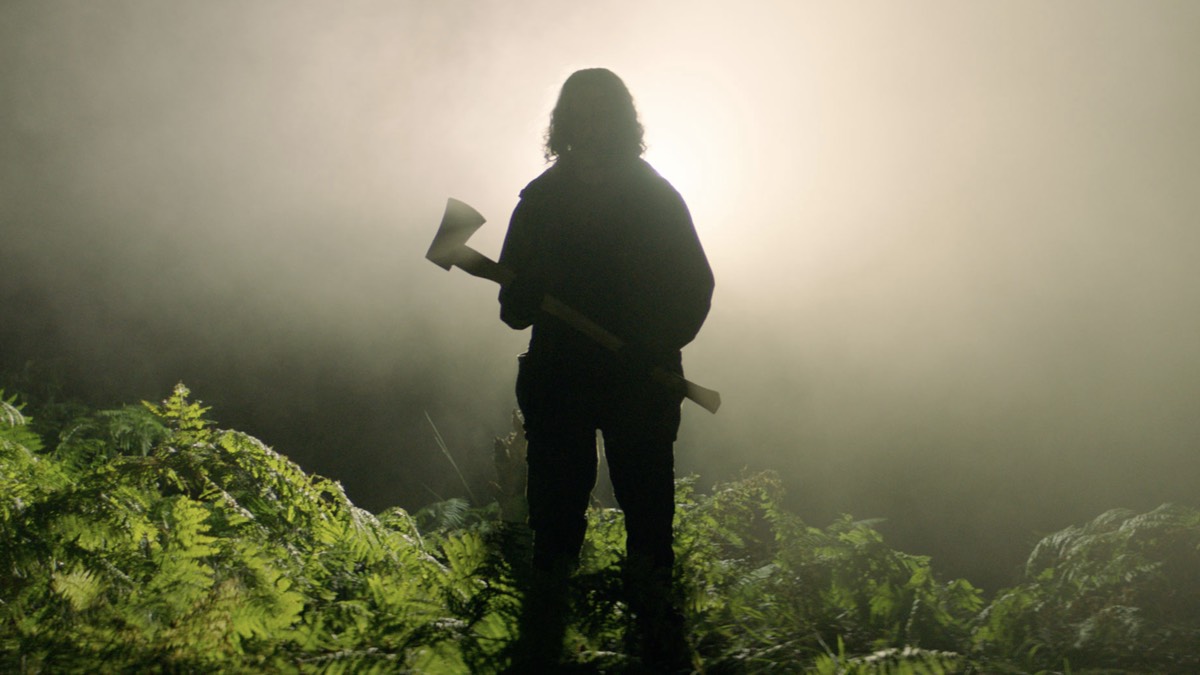
And so we arrive at the final film of my 2021 #31DaysofHorror, Ben Wheatley’s In the Earth. Wheatley is always interesting, and Kill List is a masterpiece, so I was happy to see him return to folk horror. He does a particular type of British awkwardness like nobody else (see Happy New Year, Colin Burstead), and that tone is present in spades here.
Martin arrives at a woodland camp controlled by the government during a deadly pandemic. He is looking for an ex-colleague, scientist Olivia Wendle, who is doing research deep in the woods. It’s a two-day hike to reach her camp, so he needs the help of park guide Alma, who tells him about the legend of the woodland spirit Parnag Wegg. They are attacked in the night, and helped by Zach, a man who lives in a makeshift camp nearby, but when he claims the trees talk to him, they begin to suspect his help comes at an awful price.
It’s a fascinating, horrible, blackly funny film about Covid, nature, group dynamics, and how humans exist in relation to other forms of life. Olivia and Zach are abusive parental figures, and Martin and Alma are trapped in their co-created psychosis. Zach has a straightforward manner that barely hides his intrinsic brutality, while Olivia’s scientific method quickly devolves into cult-speak and witchcraft. Both want to use Martin’s niceness and open-mindedness to speak to the woods through the pleasingly spooky altar stone, but it’s the pragmatic Alma who is the voice of reason and eventual conduit to the realm beneath their feet.
October 30 2021, 19:47
Ghostbusters II (1989)
Director: Ivan Reitman
To finish my parade of eighties sequels, I went with Ghostbusters II, which I can remember seeing in the cinema with friends back in the day. My father took me to see the original Ghostbusters, at Swansea Odeon, when I was eleven years old. I have a wonderful memory of feeling scared by the librarian ghost in the New York Public Library, and then laughing uproariously with my father as they ran outside. I’d never seen him laugh like that before, uninhibited and really enjoying himself. The whole theatre was in pieces. Magical.
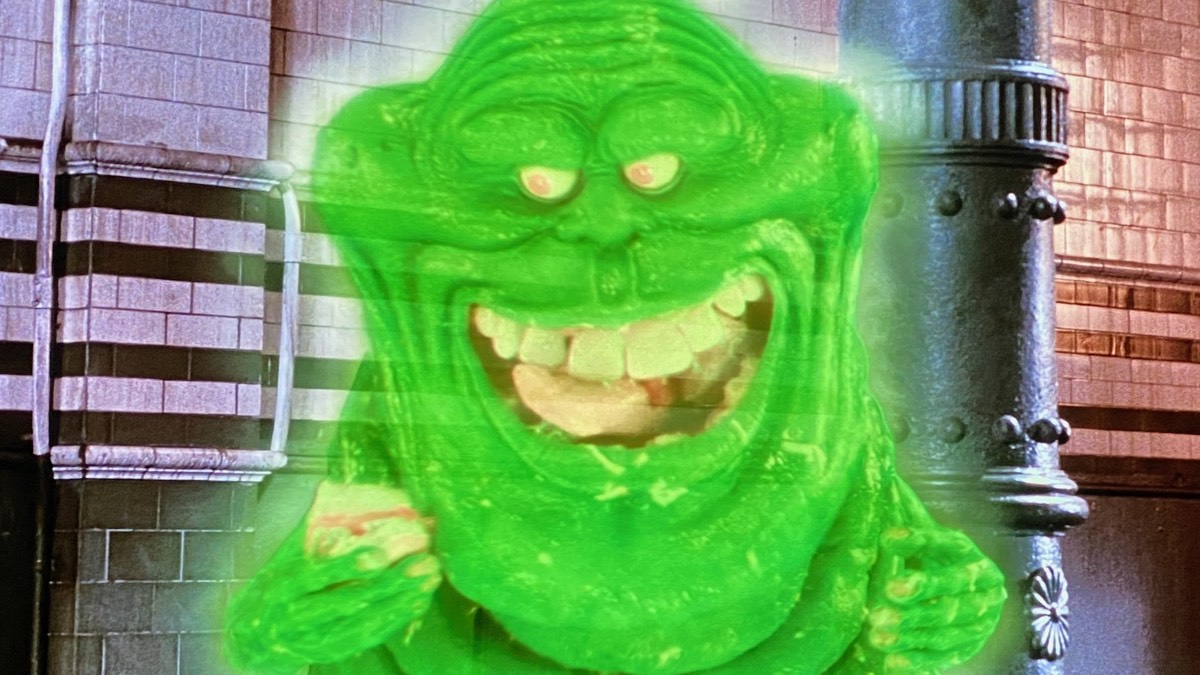
Five years after defeating Gozer, Ray, Egon, Winston and Venkman are out of business. Dana works at an art museum and has a baby, Oscar. One morning she runs her pram through a sliver of red slime on the pavement. The pram takes on a life of its own, racing through traffic, and Oscar barely survives. Thinking it was a ghost, Dana asks Egon to investigate, and soon the old team have discovered a river of slime running through abandoned subway tunnels under the city. Meanwhile, Dana’s boss, Janosz, is restoring a painting of Vigo the Carpathian, an evil sorceror, who needs to possess the body of a baby at the stroke of midnight on New Year’s Eve if he is to conquer the world, and because Janosz likes Dana, Oscar becomes the target.
The four ghostbusters don’t fully rekindle the chemistry from the first film, so the first act feels awkward and not very funny. I’m surprised again at how unpleasant Bill Murray could be in the eighties; I have no idea what Dana sees in Peter Venkman. The best bits usually involve the supporting characters, Dana, Louis, Janine, and Janosz, who liven things up with some heart and good comic acting. The special effects still look pretty good, but I wish there were more ghosts, and it was always a losing battle trying to replace Ray Parker Jr’s legendary theme song, so the ghost fight scenes feel flat.