
January 13 2026, 21:01
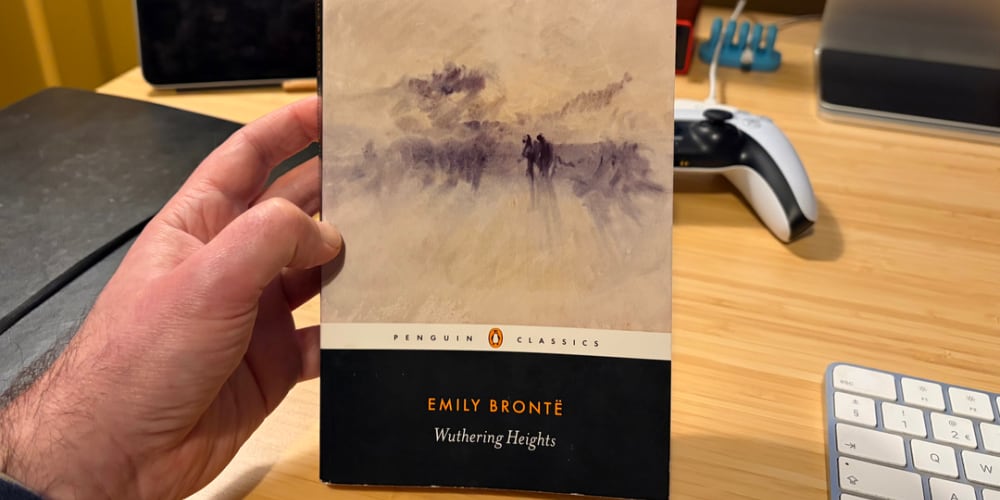
Wuthering Heights
Mr Lockwood, via Nelly Dean, first/second person, ~200,000 words.
I didn’t finish Wuthering Heights. I got about a third of the way through before I became stuck in the sludgy swamp of the prose and subject matter. I picked it because I saw a trailer for the upcoming Emerald Fennell adaptation in the cinema, and also it was my mother’s favourite book—I have a copy signed by her from childhood—so I gave it as much leeway as I could manage before the relentless misery and suffering snuffed my energy for it out.
The book is not at all the romantic story culture has made it seem like. The various adaptations play on doomed romance and star-crossed lover tropes that are just not in the novel. Heathcliff is violently abused and becomes monstrous. Cathy is a narcissist. As young stepbrother and stepsister, they are terrors around the house, rude to everyone and unpleasantly mischievous.
In the opening scenes, the hapless Lockwood goes to Wuthering Heights out of curiosity and is met with a dilapidated house where he is denied entry, mocked by owner Heathcliff, attacked by his dogs, refused a place to sleep when a snowstorm hits, and eventually given a chair in a haunted room. It's a relentless exercise in discomfort. Undetered, the nosey Lockwood encourages his landlady, Nelly Dean, who used to work at Wuthering heights, to tell the story of how Heathcliff came to be as he was. We learn Heathcliff was a rescued orphan, bullied by his jealous stepbrother, Hindley, and besotted with his kindred-spirited stepsister, Cathy.
The story turns on an incident where both children play a prank on a neighbouring house, home of children Edgar and Isabella Linton. Cathy is hurt and taken in for several weeks to the Linton household where she is taught the manners and fashions of a lady. Heathcliff is blamed disproportionately for the prank and is punished harshly, so when Cathy returns Heathcliff has become almost feral, and this schism in their relationship eventually becomes permanent.
Throughout his childhood, Heathcliff is brutalised and blamed for much that is not his fault, so it makes sense that he would want revenge. As the book went on, I began to realise that his behaviour was so abhorrent and sustained that there was going to be no redemption. Cathy’s behaviour was repellent in different ways. I kept getting confused with people’s names, jumps in time, genealogy, property law—it was a hard book to follow, and the events told were consistently unpleasant. It was beginning to make me feel miserable (and not in a good way!), and I began to avoid reading it.
So, I read the synopsis on Wikipedia, and seeing where it was going, decided to call it a day. I'm not sorry I missed out on the vengeful sadistic marital abuse. I’m glad I gave it a go. I certainly have a decent knowledge of the story and characters, so I’m marking it as read and moving on.
Previous: 2025: Best films, books and music | Next: The Expansion Project