
June 07 2025, 11:58
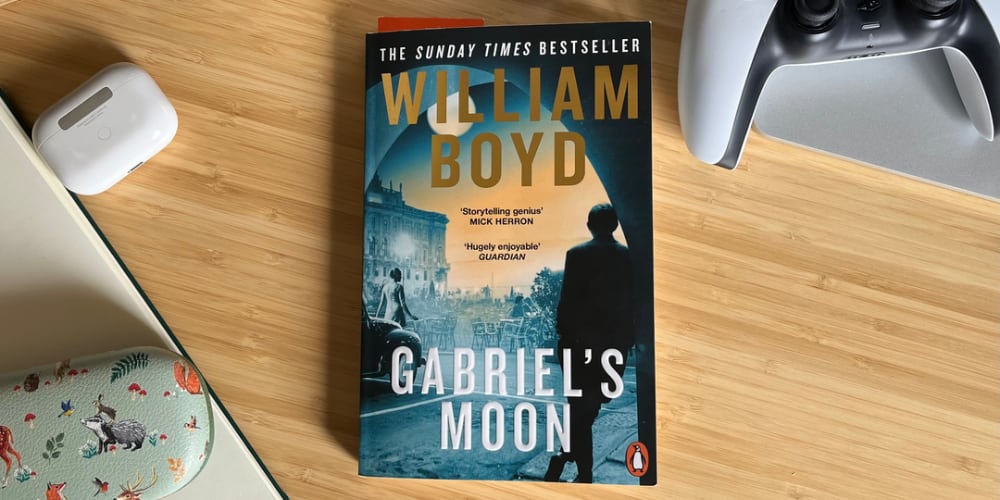
Gabriel’s Moon
Penguin. ~100,000 words. Third person limited, as Gabriel.
I was looking for something literary and genre, and I remember loving Any Human Heart many years ago. I know Boyd has written several spy novels, but I didn’t finish the last of his I tried (a whodunnit about Freud and Vienna), Waiting for Sunrise. I find whether I enjoy a book hinges on the time in my life, what I’m looking for, my mood, all sorts of things. That doesn’t sound very academic, but then... I’m not an academic.
It opens with a young Gabriel Dax escaping a house fire. His mother dies and he is brought up by an art dealer uncle, away from his much older brother, Sefton. In his late twenties, making a modest living as a non-fiction writer and journalist-for-hire, he tapes an interview with a dictator in the Congo who is convinced he is to be assassinated. Returning to London, Gabriel hears on the news that the man was indeed killed, and the tapes he made have become hot property. He is slowly pulled into the world of MI6 by an enigmatic handler, Faith Green, who begins to pay him to do small errands across Europe. At the same time, he is seeing an analyst for his insomnia and nightmares who encourages him to find out more about his mother’s death.
After the more experimental approaches of recent books I’ve been reading, this was a traditional, straight-down-the-middle spy novel given sparkle by Gabriel’s vivid characterisation and parallel investigation into whether his night light really did burn down his family home. Boyd gets us into the head of someone being gradually seduced away from a relatively dull life into a more exotic and dangerous world. There are transcripts from his taped sessions with his analyst, Dr Katerina Haas, and excursions to meet loss adjusters and firemen in rural Oxfordshire, alongside days spent on unexplained assignments in Spain and Poland.
I liked the balance between plot (keeping the mysteries alive) and character (so I cared what happened to Gabriel). It’s the longest book I’ve read in a while, but it didn’t feel it because the prose is silky smooth in the main. My editor brain can’t help but find some bits a bit clunky, but that’s just my taste showing. This is how William Boyd does it. I’m not complaining. There’s lots to learn in here.
Previous: Reconfiguration | Next: Soft machine