May 30 2026, 18:18
Free play
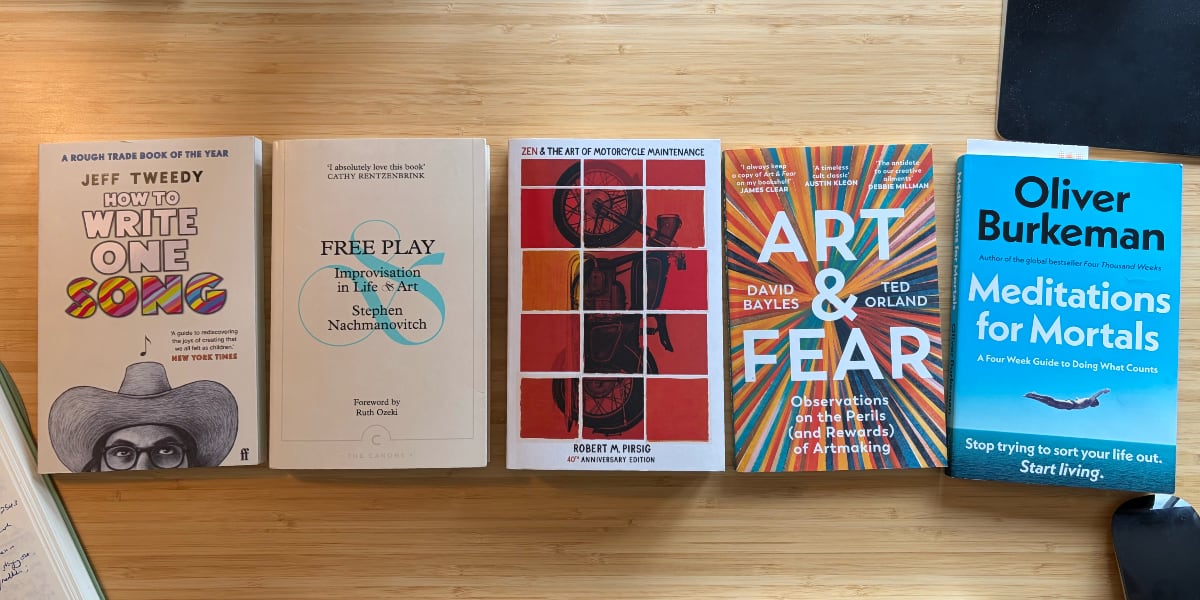
I’ve been reading a lot of books about the psychological aspects of making art:
- How to Write One Song, Jeff Tweedy
- Free Play, Stephen Nachmanovitch
- Zen and the Art of Motorcycle Maintenance, Robert M. Pirsig
- Art & Fear, David Bayles & Ted Orland
- Meditations for Mortals, Oliver Burkeman
There’s a tremendous amount of practical wisdom distilled into all these books.
This spurt of May research was triggered by a few things. In March, I split my one (true) notebook out into four—for creative writing, songwriting, art, and life in general. A parental voice in my head was telling me to “just fucking pick one or you won’t get anywhere”, but I know now that’s fighting my nature and simply doesn’t work.
With a new songwriting notebook, it became clear my guitar lessons weren’t taking me in the direction I wanted, so I decided to take a break. My writing brain wanted to write songs, even though I was still a beginner on guitar—guitar technique didn’t interest me, not yet anyway, and I’d learned enough to explore songs on my own for a bit.
I got into a good groove with the creative writing notebook. The art notebook remained empty. At the same time, I was watching YouTube channels on learning languages, learning multiple skills in parallel, software engineering, guitar, piano, singing, and yes, starting a YouTube channel. As a technician, I wanted to know how it worked behind the scenes.
This is a known pattern I fall into. Being thought-scattered without a project(s) to practice on feeds my discontent. It feels like procrastination, even though I’m not working on anything. The year wasn’t going how I wanted. Old patterns were returning. Whenever I’m looking to find some clarity and coherence, I turn to books.
Jeff Tweedy, in the intriguingly-named How to Write One Song, writes like a wise, kind friend, and his advice is backed up by musical success with the band Wilco. There are lots of specific techniques in the second half about writing songs, but my main takeaway is the importance of both treating songwriting lightly—to play like a child, for the fun of it, because it’s joyful to do—and being serious enough to do it often, with attention, care and craft.
In Free Play, Stephen Nachmanovitch, as a professional improvising violinist, has a wealth of wisdom to share on the improvisation part of making art. He brings a more spiritual, slightly philosophical perspective, but the book is still an easy read. He stresses the importance of listening to the unconscious while making. Pre-conscious material can be channelled through the body and fingers. Improvising is a practice of moment-by-moment micro-experiments where things are tried, they work as expected or don’t, and so on. There are no mistakes, just an endless conversation in whatever medium the artist is working in, continually spinning raw material into existence.
I went to Zen and the Art of Motorcycle Maintenance next because this was one of the books from my mid-twenties that got me into software engineering, and I sensed it might have something to say about my current problems with “art engineering”. It’s a philosophical enquiry into the experience of doing technical work, and through the concept of Quality, teases out the role of intuition in understanding and solving problems. Pirsig doesn’t talk about generating art, but instead states that doing work well is the bridge between technology and the arts.
I picked up Art & Fear because I wanted to be thorough, and it’s a slim book, another one from my soul-searching twenties. It lists the blocks, both internal and external, that an artist can experience, and offers advice on getting around them. Like Tweedy, it strongly advocates for art to be something ordinary, daily, normal, and not tied too tightly to identity and being successful. To create from inside yourself is to be vulnerable, and that’s the difference between making art and making crafts. Artists have to find a way to bare their souls while not taking the response of the world too seriously. That one hit home.
Finally, Meditations for Mortals, by Oliver Burkeman, cleansed my palate nicely, taking a down-to-earth look at what it’s like to live in today’s always-on, everything’s-available, anything’s-possible culture. It makes people unhappy, and he says that by facing up to our (often grim) reality we can relax and do what’s actually important to us.
Those were five books about being creative that look at different aspects of making things in a world that can feel overwhelming. I recommend them all (with a caveat on Zen and the Art of Motorcycle Maintenance, because it was least impactful to me now and took a lot of energy—and I skipped some of the history of philosophy sections this time!).
What did I learn? What was I made to remember?
- Finish small projects often, and learn while making things. Write songs on guitar when still crap at guitar.
- Forget external validation, be ambitious to make good stuff that could only come from you.
- Separate improvising from editing. Get material into the world, then work on it. Create systems that make this easy.
- The best raw material comes from listening to what’s bubbling up from the unconscious.
- Be joyful, playful, relaxed, and lose yourself in making things.
- Playing as kids was pure art-making, self-making. It was ordinary. It was a daily thing. Collaboration was easy. Knowing what you liked was easy. Losing yourself in doing something was easy. That’s the state to get into.
- Let the ideas and feelings flow, and express yourself in play.